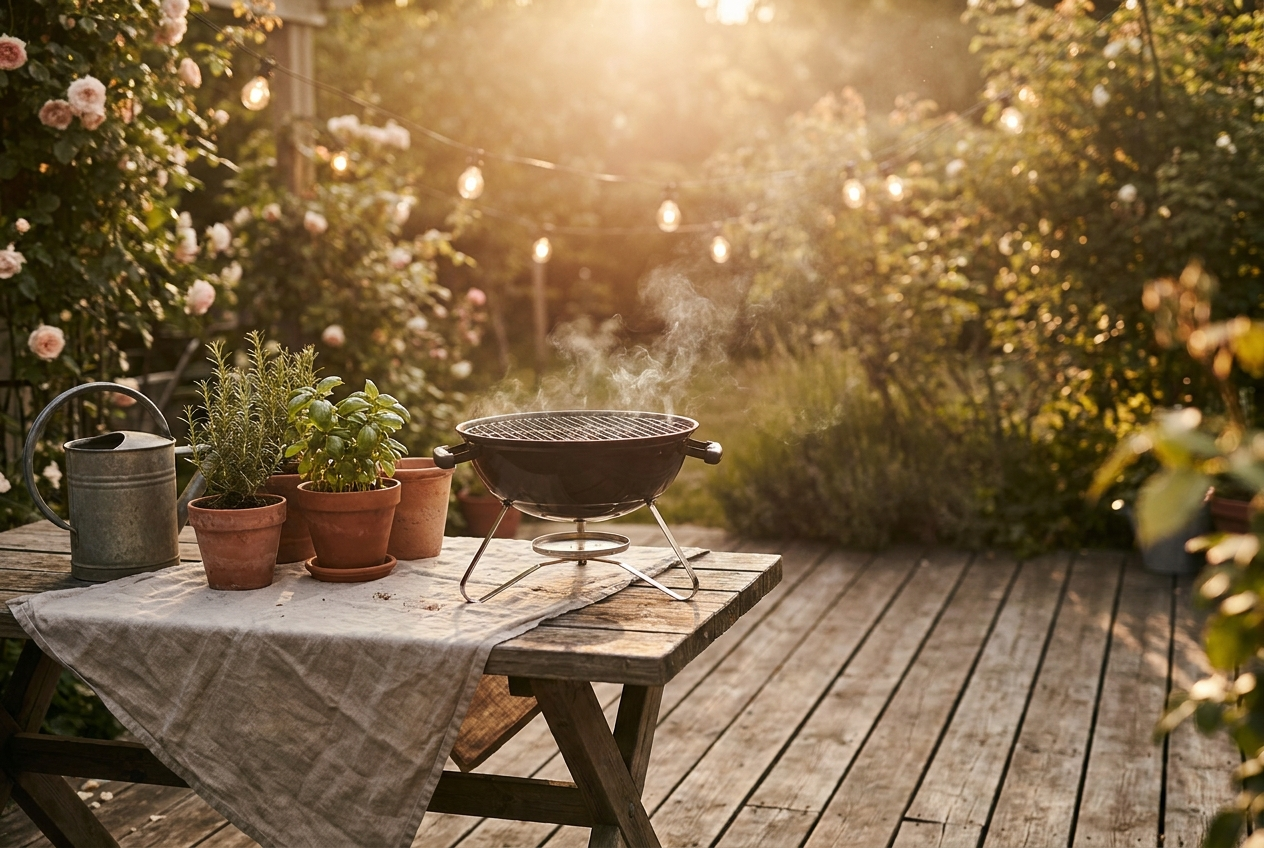
From June to September the geography of the home changes: the real living room is outside. The balcony, the terrace or the garden become the room where you eat, read and entertain — and like any room, it works if it is equipped with judgement. This guide walks through the four concrete questions of the domestic summer: cooking outdoors without improvising, keeping plants alive even when you leave, coping with the heat without blowing up the electricity bill, and bringing order to spaces that work double shifts in summer. As always: few objects, chosen well, made to last. Tried, documented, useful.
1. The garden as an extra room
Before any purchase, one criterion. Outdoor space suffers from two opposite diseases: emptiness — the bare balcony where nobody wants to sit — and accumulation, the garden-warehouse full of objects that winter will ruin. The middle way is built by answering a single question: what do I actually do out here, in a typical week? Whoever dines outside three evenings a week invests in outdoor cooking; whoever reads on Saturday mornings invests in shade and seating; whoever keeps plants invests in water. The mistake is buying for the imagined scenario — the grand barbecue for twelve — instead of for real use.
The reverse rule also applies: everything that stays outside must survive outside or be easy to bring in. Materials that do not fear a sudden storm, folding objects, removable covers. A well-equipped garden takes an hour to pack up at the end of September.
2. Cooking outside: the charcoal barbecue, starting small
Outdoor cooking is the heart of the domestic summer, and the charcoal barbecue remains its best-loved tool: no electric grill returns the same flavour. The surprise is that you do not need the American-garden steel monument to start: you need a cooking surface sized for how many people actually sit at your table.
The portable format
For two to four people, a folding portable charcoal barbecue like the Foldecue covers the whole season: it opens in one movement, sits on any stable, heat-resistant surface, and at the end of the evening folds flat onto a shelf. It is also the only format that follows you on day trips — lake, camping, rented house. The criteria that matter: the stability of the legs once open, a steel grill you can remove and wash, and adjustable air vents that govern the embers.
The rules of charcoal
Three habits separate the good barbecue from the nervous one. First: light the charcoal at least half an hour before cooking — you cook over grey, even embers, never over flame. Second: divide the grill into two zones, one with more embers for searing and one with fewer for finishing without burning. Third: clean while the grill is still warm, with a metal brush — thirty seconds that save half an hour of soaking the next day.
Charcoal or briquettes?
A recurring question, a practical answer. Lump charcoal lights faster, reaches higher temperatures and smells better, but burns quickly: the right choice for fast cooking — skewers, vegetables, burgers — which is the natural repertoire of a portable barbecue anyway. Briquettes, pressed and uniform, start slower but hold steady embers for hours: they make sense for long cooks and large lidded barbecues. For the folding balcony format, medium-sized lump charcoal without hesitation: half a chimney starter is enough for a dinner for four. And lighting is done with the chimney or firelighter cubes — never, for any reason, with alcohol or petrol: besides being dangerous, they leave their taste on everything you cook.
And safety, which on a balcony is no detail: the barbecue works away from curtains, foliage and tablecloths, on a non-flammable base, and the ash is disposed of only when completely cold — twenty-four hours, or a bucket of water and then the bin. Every building's rules have the last word on open embers: reading them first costs less than arguing later.
3. The step up: the pellet pizza oven
For a few years now, outdoor cooking has had a second season: compact pizza ovens. A pellet model with accessories like the InnovaGoods Pizzahven brings to the garden table what no domestic oven reaches: the 400-plus degrees of Neapolitan baking, with a pizza ready in a couple of minutes.
What to know first. The pellets are the same as stove pellets — cheap and easy to find — and the flame needs a hopper fed by hand every few minutes: this is an oven you govern, not one you programme. The learning curve is real: the first two or three pizzas come out imperfect, and you learn to turn them with the peel mid-bake because the heat comes from the floor and from one side. The baking stone needs about twenty minutes to come up to temperature before the first pizza, and is never washed with soap: it is scraped cold. It is the right purchase for those who have already made home pizza a ritual and want the real quality jump — for everyone else, better to start with the barbecue.
4. Water in summer: plants alive even when you leave
July and August are the gardener's paradox: the moment plants are thirstiest is the moment you leave on holiday. Solutions exist, in increasing order of effort.
Slow-release watering
For pots, the simplest solution are gradual-release dispensers: the Ballwooters automatic watering globes are filled with water and pushed into the soil, where they release moisture for days as the ground dries. Four globes cover four medium pots for about a week: the right measure for the short holiday. For longer absences, combine them with moving the pots into the shade — a pot out of direct sun uses half the water.
The right pot matters as much as the water
Half of all watering problems start with the container. A well-made resin pot like the Stefanplast STF795 holds moisture better than terracotta — which breathes and is beautiful, but in summer dries out in hours — and is light enough to be moved into the shade before you leave. The golden rule remains drainage: holes in the bottom and a saucer that never stays full for days, because standing water kills more plants than drought.
Mulching, the oldest trick in the book
Then there is a gesture that costs almost nothing and changes the water arithmetic: covering the soil. Two fingers of mulch — bark, dry leaves, even light gravel in pots — shield the ground from direct sun and cut evaporation by up to half. In pots it also works as thermal insulation for the roots, which on torrid days suffer more from scorching soil than from thirst. Spread once in June, it works silently until September: no other garden investment returns so much for so little.
One last habit, the cheapest of all: water in the evening. Water given at eight in the evening works all night; water given at noon evaporates before reaching the roots.
5. The heat indoors: good ventilation costs little
While the garden enjoys its best season, indoors the summer presents its bill. Before thinking of air conditioning — which remains the heavy solution, for the truly torrid weeks — there is an intermediate step that consumes ten times less: ventilation done well.
The ceiling fan is back
The ceiling fan is the most underrated summer machine: it moves the air of a whole room at minimal consumption, silently. Current models have solved the aesthetic problem too: a ceiling fan with RGB LED light and retractable blades looks like a ceiling lamp at rest — the four blades extend only when it spins — and the remote manages speed and light from the sofa. On the warm LED light version the logic is the same, in a more sober key. The real buying criterion is the diameter: up to 15 square metres compact blades are enough; beyond that you need larger diameters or two ventilation points.
The portable that follows people
The complement is the personal fan: a rechargeable desk fan like the FanLED, with its 4000 mAh battery, works for hours without a socket — desk, bedside table, balcony table. It does not cool the room: it cools you, which is what you need exactly where you are. The ceiling-plus-portable pair covers ninety percent of the summer; for the other ten percent, air conditioning should be chosen calmly and installed by expert hands, not bought on impulse during the heatwave.
Night ventilation: free, if done with method
The third tool is not bought: it is organised. Houses overheat because they accumulate heat by day and fail to discharge it by night. The method is simple and must be followed to the letter: closed by day — windows and shutters down on the sunny side, as the South has always done — and everything open at night, creating a through-draught between opposite sides of the house. The fan multiplies the effect: pointed outwards at a window, it pushes out the day's hot air and draws the night's cool air from the other rooms. Half an hour of this before bed is worth a degree of air conditioning — at zero cost.
6. The order that makes the house feel cooler
Finally, a truth rarely spoken: in summer the house works double — towels coming and going, swimsuits drying, linens in constant rotation — and order is the first form of comfort. Three minute details make a difference out of proportion to their price.
The towel ring: an aluminium ring like Confortime's next to the basin or the garden door gives a home to the towel that changes hands ten times a day in summer — and aluminium fears neither humidity nor wet hands. Wooden hangers: a set of Gift Decor wooden hangers earns its place more in summer than in winter, because light linen and cotton crease the moment they are folded — hung up, they iron themselves. And home fragrance: with windows open at alternate hours and textiles working overtime, an Air Wick diffuser refill keeps the hallway and bathroom fresh without becoming intrusive. Small things — but small things are exactly what a house that works in summer is made of.
7. Maintenance: closing the season well
An equipped garden lasts if September does not catch it by surprise. The barbecue is stored clean: grill brushed, bowl emptied of ash, a wipe of cooking oil on the steel parts against rust, and rest in a dry place. The pellet oven wants an empty hopper — leftover pellets absorb moisture and will not light in spring — and a scraped stone. Empty pots are cleaned and stacked upside down so frost cannot crack them; watering globes are emptied and stored dry. The fans ask only for a dusting of the blades before their winter rest: accumulated dust is the reason they restart noisy in June. An hour in all, and next May the garden reopens in an afternoon.
8. The most common mistakes (and how to avoid them)
Buying for the scenario, not the use. The barbecue for twelve used twice a year occupies the balcony for twelve months. Size it on the typical week, not the hypothetical party.
Ignoring the building rules. Open embers on the balcony are not allowed everywhere. Check first: the peaceful barbecue starts there.
Watering at noon. Half the water evaporates and the drops on sunlit leaves act as lenses. Evening, always.
The saucer full for days. Standing water suffocates the roots: it kills more plants than thirst. Drainage, and an emptied saucer.
The air conditioner bought during the heatwave. Bought on impulse, chosen badly, installed worse. Ventilation covers the wait; air conditioning gets planned.
Storing everything dirty at the end of the season. Ash in the bowl, pellets in the hopper, soil in the pots: the three surest ways to buy everything again next year.
The Dedal selection
The products mentioned in this guide, all available in the Home and Garden category of the Home world:
- Foldecue folding portable charcoal barbecue — the grill that opens in one movement and follows you on trips
- Pizzahven pellet pizza oven with accessories — real 400-degree pizza, on the garden table
- Ballwooters automatic watering globes, 4 units — plants drink by themselves while you are on holiday
- Stefanplast STF795 pot — light, moisture-retaining, moved into the shade in a second
- RGB LED ceiling fan with retractable blades — ceiling lamp in winter, fan in summer
- FanLED rechargeable desk fan — 4000 mAh of personal cool, no socket needed
- Confortime aluminium towel ring — everyday order that does not fear wet hands
- Gift Decor wooden hangers — hung linen and cotton iron themselves
FAQ
Can I use a charcoal barbecue on the balcony?
It depends on your building rules and local ordinances: many allow it provided you avoid disturbing neighbours (smoke) and operate safely. The practical rules do not change: away from flammable materials, on a stable base, ash disposed of cold.
Are watering globes enough for two weeks away?
On their own they generally cover a week on medium pots. For two weeks, combine measures: pots moved into the shade, generous watering at departure, freshly filled globes — and for the most demanding pots, a kind neighbour remains the best technology available.
Is the pellet oven hard to use?
Not hard, but it asks for presence: the hopper needs feeding every few minutes and the pizza needs turning mid-bake. After two or three sessions the gesture becomes natural. Those looking for a light-and-forget tool will be disappointed; those who love the ritual will find it part of the fun.
Ceiling fan or portable air conditioner?
They answer different problems. The fan does not lower the temperature but greatly improves how it feels, at minimal consumption: the solution for most summer evenings. The air conditioner truly cools but consumes and needs proper installation. The reasonable sequence: ventilate well first, then judge whether more is needed.
How much charcoal for a barbecue for four?
Less than you think: on a portable barbecue, about half a kilo of medium lump charcoal covers a full session — vegetables, meat, toasted bread. The secret is not quantity but management: embers arranged in two zones, and air vents to govern the temperature instead of adding charcoal mid-cook.