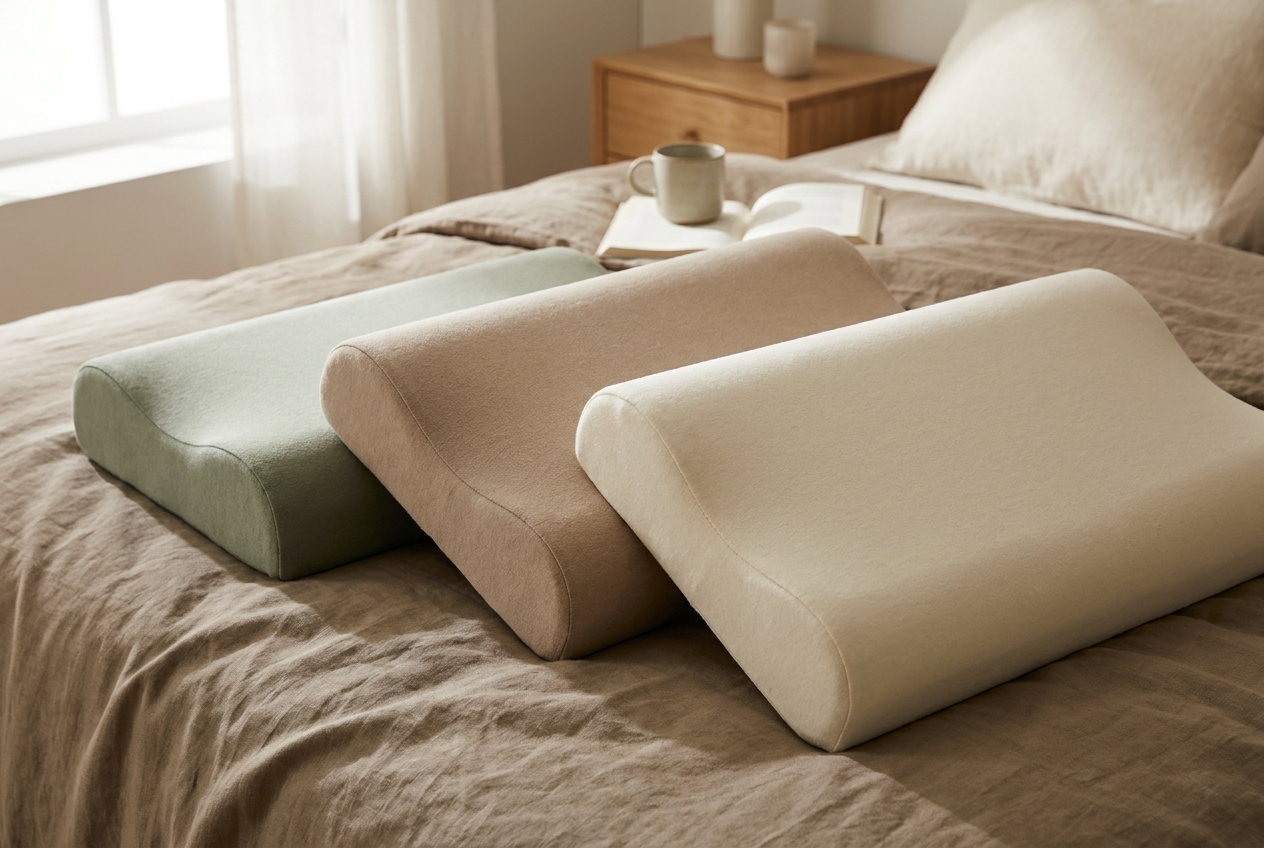
The pillow is the object that touches the body for more hours than any other — a third of a lifetime, if we sleep as we should — and yet it is the one we choose with the least care. We take whatever is there, keep it until it collapses, and get used to the wrong support without noticing, later blaming the mattress or stress for nights when we wake up more tired than when we lay down. This guide lines up the criteria that really matter: the position you sleep in, height and support, materials, breathability, hygiene. One premise we will repeat: a comfortable pillow improves rest, but it is not a medical device and cures nothing. If you have persistent neck or back pain, the first step is to talk to a professional; this guide is for choosing the comfort of each night better, not for solving health problems.
1. The first question: how do you sleep
Before even looking at materials and prices, look at yourself: in what position do you spend most of the night? It is the criterion that guides everything else, because a pillow is not comfortable in the absolute, it is comfortable for a posture. Choosing it without starting here is the number-one reason for bad purchases.
On your side. It is the most common position. Here you need a fairly high and firm pillow, able to fill the space between the shoulder and the neck so that the head stays aligned with the spine and does not "drop" towards the mattress. A pillow that is too low, for a side sleeper, leaves the neck bent all night; it is the most common cause of waking up with a stiff neck.
On your back. You need medium support that follows the natural curve of the neck without pushing the head too far forward. Pillows with an ergonomic contour — lower in the centre and slightly raised under the neck — are designed precisely for this position, because they maintain support without forcing.
On your stomach. It is the hardest position to accommodate: here a high pillow forces the neck to twist. Front sleepers should prefer a very low, soft pillow, or even no pillow under the head, moving instead a thin support under the pelvis.
Many of us change position during the night, but almost everyone has a prevailing one. Identifying it — even just by asking whoever sleeps next to us what position they find us in each morning — is the most useful starting point of the whole choice.
2. Height and support: the criterion that changes everything
After position, the decisive factor is the height of the pillow, which in the trade is called loft. The goal is simple to state and hard to get right by eye: the head and neck must stay aligned with the spine, neither tilted upward nor let fall downward. A wrong height, one way or the other, is what turns a pillow into a nuisance.
The right height depends on two things: position (we have seen it) and build. Someone with broad shoulders, sleeping on their side, needs a higher pillow to fill the greater distance between neck and mattress; someone with narrow shoulders can go lower. The mattress matters too: on a very soft mattress the shoulder sinks and you need a lower pillow; on a firm one the shoulder stays on the surface and you need more loft.
Support — how much the pillow yields under weight — is the other half of the criterion. A pillow that is too soft flattens and effectively lowers the height during the night, undoing the choice; one too firm does not adapt to the curves and creates pressure points. The middle ground — a material that yields just enough to receive the head but returns to shape without flattening — is what distinguishes a good pillow from one that is already "dead" after a month. Viscoelastic materials, which we discuss shortly, exist precisely to balance adaptation and recovery.
One last practical tip on height: allow yourself a few nights of adaptation. The body takes some days to get used to a new support, and a correct pillow can feel "strange" at first simply because it corrects a posture we were used to. The rule is to distinguish the discomfort of habit, which passes in three or four nights, from the real one, which instead worsens: if after a week you still wake up with a sore neck, the height or the support is not the right one for you, and it is worth trying a different configuration.
3. Materials: what really changes
The inner material decides the character of the pillow: how it yields, how much it heats, how long it lasts. There is no best material, there is the one suited to how you sleep and how much you suffer the heat.
Memory foam (viscoelastic)
Viscoelastic foam moulds to the head and neck with heat and weight, then slowly returns to shape. It is the choice most appreciated by those seeking a support that "embraces" and distributes pressure evenly, typical of pillows with an ergonomic contour. The downside is that traditional memory tends to retain heat: those who sweat at night often find it too warm, which is why versions with gel or ventilation channels were born.
Gel and cooled foams
Adding gel or gel-infused layers to the foam was born precisely to solve the heat problem: gel disperses body warmth better and keeps the surface cooler to the touch. It is the sensible choice for those who experience a warm pillow as a nuisance, or simply for summer.
Honeycomb and perforated structures
Some pillows adopt an internal honeycomb or perforated structure: the geometry creates air channels that increase ventilation and lighten the pillow, offering a more "elastic" and very breathable support. It is a good compromise for those who want adaptation without the sinking sensation typical of denser memory.
Fibre and traditional materials
Synthetic-fibre or feather pillows remain the most common and the cheapest. They are soft and light, wash more easily, but tend to flatten sooner and offer less constant support over time. They are perfectly fine for the guest bed or for those who change position often and are not looking for a precise contour.
One last word on covers: many quality pillows have a removable cover, often in technical breathable fabrics or, in some cases, with bamboo-charcoal treatments designed to absorb moisture and odours. A cover that comes off and washes is, as we will see, a hygiene criterion as much as a comfort one.
4. Not just under the head: positioning cushions
The world of cushions does not end under the head. There is a whole family of positioning cushions designed to support other parts of the body, in bed or on the sofa, and they are often the ones that change comfort most for those who spend many hours still.
Between the knees. For side sleepers, a shaped cushion between the knees keeps pelvis and legs in a more natural rest, reducing the tension that arises when the upper leg "slides" forward. There are specific models for knees and legs, with a shape that keeps the legs apart without slipping during the night.
Under the lower back. A lumbar cushion, in gel or foam, supports the low curve of the back when seated for a long time — at the desk, in the car, on the sofa — or lying down. It corrects nothing, but it makes staying still more bearable, which is already a lot.
For reading and semi-seated rest. Reading cushions with armrests, once called "husband pillows", give support to back and arms when reading or watching something in bed. They are comfortable precisely because they replace the unstable pile of pillows that each of us has tried to build at least once.
The common point of these cushions is that they answer a precise moment of the day, not a sleep position. Choosing them starts from the same question as the head pillow, reversed: not "how do I sleep", but "in which moment am I still and uncomfortable, and what would make it better".
5. Breathability and climate: sleeping cool
Temperature is the factor that most often ruins a technically sound pillow. Perfect support becomes useless if the heat wakes you, and this depends a lot on the material and the cover. Those who sweat at night or live in a warm climate should put breathability among the first criteria, not the last.
The solutions, we have seen, are three: gel that disperses heat, perforated or honeycomb structures that circulate air, and breathable-fabric covers. In summer, a cool pillow can make the difference between sleeping and tossing; in winter the problem eases, but a good pillow stays breathable all year, because the moisture of sweat — even minimal — is what, over time, degrades the interior and feeds bad odours.
It is worth remembering that breathability is not only about immediate comfort: a pillow that handles moisture well stays hygienically healthier for longer, because a damp environment is what favours mites and odours. Freshness and hygiene, in this sense, are the same criterion seen from two sides.
6. Removable covers, hygiene and maintenance
A pillow is an object that accumulates: sweat, skin cells, moisture. That is why the ability to remove and wash the cover is not a luxury, it is a full-fledged selection criterion. A pillow with a removable, washable cover stays fresh and hygienic for years; a sewn one does not.
Basic maintenance is simple but often neglected. The cover should be washed regularly, following the instructions: many technical fabrics do not like high temperatures or aggressive dryers. The foam interior, as a rule, is not machine-washed — water ruins memory — but is aired: leaving the pillow in the air, away from direct sun, helps release moisture and odours. Fibre pillows, on the other hand, are often washed whole, which is one of their practical advantages.
A good habit is to always use a pillowcase in addition to the pillow's cover: it is the sacrificial layer, the one you wash every week with the sheets and that protects everything else. And when a pillow starts not returning to shape, staying flattened in the morning, it is the signal that the material has finished its cycle: no maintenance brings it back, and it is time to replace it. A collapsed pillow that keeps supporting badly undoes all the other criteria.
7. The most common mistakes
The first mistake is choosing the pillow without thinking about how you sleep, taking a "pretty" one or one on offer and hoping it fits. As we have seen, without starting from position any purchase is a shot in the dark.
The second is chasing softness as if it were always a virtue. A very soft pillow is pleasant in the first few seconds, but if it does not support, it lets the head fall and creates exactly the discomfort you wanted to avoid. Comfort is not synonymous with soft: it is synonymous with alignment.
The third mistake is keeping a pillow too long. Unlike the mattress, which lasts years, the pillow has a shorter life and degrades silently: you get used, day after day, to a support that is worsening, without noticing. A simple test for memory: if folded in two it does not slowly return to shape but stays folded, it needs changing.
The fourth is ignoring heat: buying an excellent dense memory while living in a warm room and then suffering it every night. And the fifth, the subtlest, is expecting a pillow to solve a pain. A good pillow makes rest more comfortable and can remove the small discomforts of a wrong posture, but it is not a cure: if the pain is persistent, the pillow is a help, not the answer.
8. The right pillow for the right moment
Let us close by reversing the perspective: instead of looking for a single pillow that suits everything, think of the moments in which you need support. The side night calls for a high, firm pillow; supine rest an ergonomic contour; reading in bed a pillow with armrests; long seated hours a lumbar support; and for side sleepers, a cushion between the knees completes the set-up.
It does not mean buying five: it means understanding which moments weigh most in your day and starting from those. For many, the right head pillow is already ninety per cent of the benefit; for those who spend many hours still — reading, working seated, watching something in the evening — a second positioning cushion is often the purchase that changes the days most. The logic is always the same we repeat for every object: start from real use, not from the spec sheet, and choose the comfort you will actually use.
The selection
A real selection from the Dedalshop catalogue, from the head pillow to positioning cushions, designed to cover different positions and moments:
- Conforti Viscoelastic Neck Pillow with Ergonomic Contour — memory with a shaped contour, made for supine and side rest.
- Ullow Multifunction Ergonomic Pillow — a versatile shape for those who change position and want adaptable support.
- Hexafresh Honeycomb Gel Pillow — ventilated structure and gel, the choice for those who suffer the heat.
- Charnut Gel and Bamboo-Charcoal Pillow with Removable Cover — gel for freshness and a removable cover for hygiene.
- Glushion Lumbar Gel Cushion with Removable Cover — support for the lower back when seated for a long time.
- Jewel Bedding Ergonomic Knee and Leg Pillow — for side sleepers who want legs and pelvis better aligned.
- Huggilow Reading Pillow with Armrests — support for back and arms for reading or resting semi-seated.
- Wrileep 3D Cloud Pillow — a soft pillow with a particular shape, for those who sleep mainly on their back.
Mini-FAQ
High or low?
It depends on position: high and firm for side sleepers, medium with a contour for back sleepers, very low or none for front sleepers. Broad shoulders and a soft mattress also shift the choice towards more or less height.
Memory or fibre?
Memory supports more consistently and moulds to the neck, but heats up more; fibre is soft, cheap and washable, but flattens sooner. If you suffer the heat, lean towards gel or ventilated structures.
How often should a pillow be changed?
There is no fixed rule, but when the material no longer returns to shape in the morning and stays flattened, it has finished its cycle. A memory that, folded, does not slowly reopen needs replacing.
Can a pillow remove neck pain?
A comfortable pillow can reduce the discomfort linked to a wrong posture during sleep, but it is not a medical device and cures nothing. For persistent pain, talk to a professional.