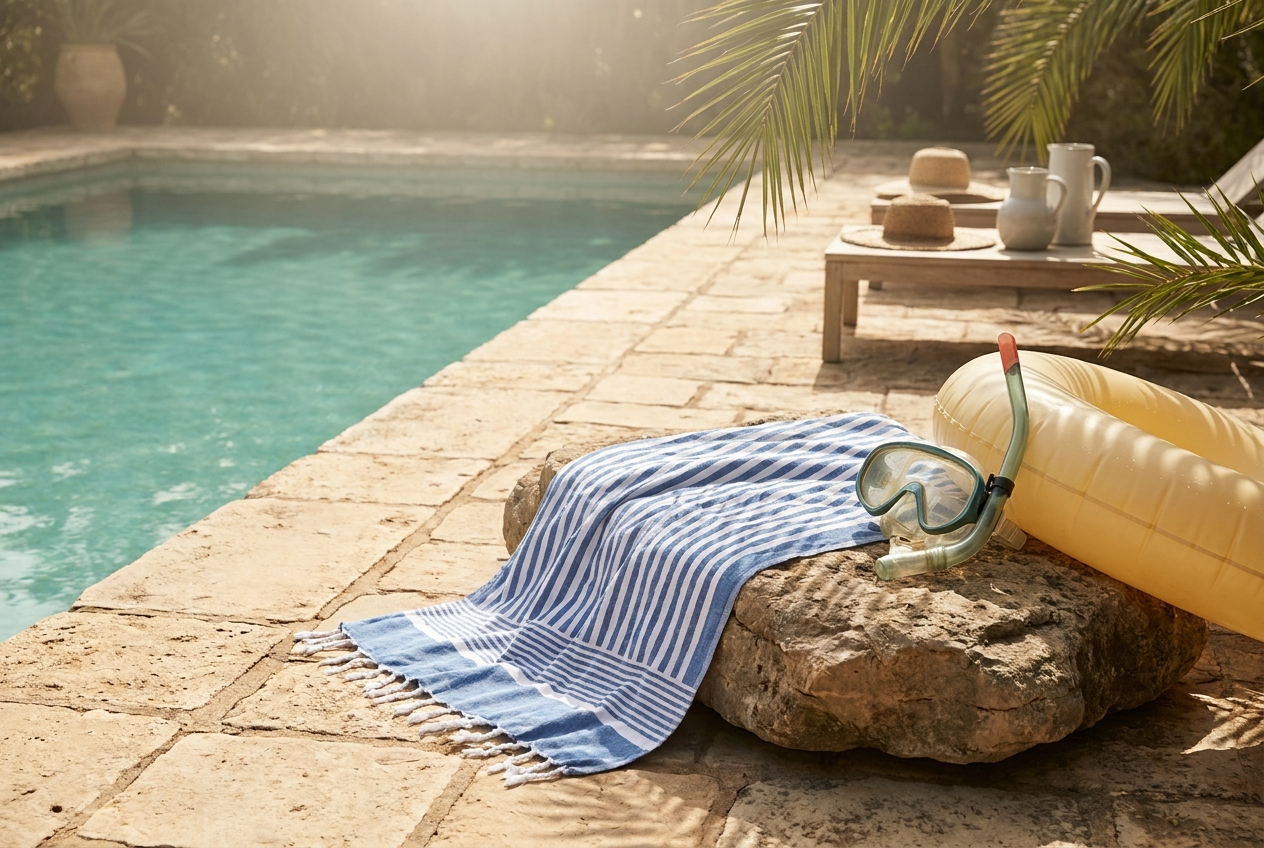
Every summer the same scene plays out: the first day at the beach or pool arrives and you discover that last year's air mattress leaks, the mask has gone cloudy, the good towel is who knows where. So you buy in a hurry, from the first display under the beach umbrella, paying double for things that won't survive August. This guide is about doing the opposite: choosing calmly, before you leave, the few pieces that really make a day in the water better — and making them last more than one season. No beach gadgets seen once and forgotten: towels, masks, inflatables, perhaps a light craft, and pools for the little ones, judged with the same criteria we would apply to any other object in the house. Tried, documented, useful.
1. The beach towel: the piece you use every single day
People tend to buy it for the pattern alone, but the towel is the beach item with the highest use-to-price ratio of all: you spread it out, lie on it, dry off with it, shake it, wash it, dozens of times per season. Three criteria matter: material, size and drying speed.
Cotton or microfibre?
Cotton is the classic towel: soft on the skin, very absorbent, machine-wash friendly, with enough weight to stay put in a breeze. The downside is that it dries slowly and takes up volume in the bag. A cotton towel around 100 x 160 cm, like the Secaneta striped beach towel, is the right choice for the settled beach day: you arrive, you spread out, you stay.
Microfibre flips the priorities: it weighs next to nothing, compresses into a corner of the backpack and dries in a fraction of the time cotton needs. It feels different — smoother, less enveloping — but for anyone who moves around, makes multiple stops or travels light it is the more rational choice. A microfibre towel takes up as much room in your bag as a t-shirt: it is the perfect backup towel and the first towel of anyone heading to the lake after work.
The right size
Below 90 cm of width you lie uncomfortably; above 160 cm of length the towel becomes a bedsheet that is hard to shake out and slow to dry. The 90-100 x 140-170 cm range is where an adult should be. For children it is worth going down a size: a 70 x 140 cm beach towel can be carried, spread and shaken by the child alone — their own corner of the beach, their own responsibility. A versatile in-between format is the Regatta Travel Giant towel, 160 x 90 cm, designed for people who use it on holiday as much as at the gym or the indoor pool.
2. Masks, goggles and snorkel: seeing well underwater
Snorkelling is the summer activity with the lowest barrier to entry: a decent mask and a stretch of coast are enough. Which is exactly why the market is full of cheap masks that fog up, let water in and end up in the bin by late August. The criteria for choosing well are few and precise.
What to check before buying
The glass. Serious masks use tempered glass: it does not scratch on sand and, in case of impact, does not shatter into shards. Plastic lenses cost less but scratch at the first contact with rocks — and a scratched lens underwater is a useless lens.
The skirt. The edge that sits against your face must be silicone, not rigid PVC: silicone follows your features, keeps water out and leaves no marks after half an hour. The classic shop test — press the mask to your face without the strap and inhale through the nose: if it stays on by itself, the seal is there — works just as well at home, the moment the parcel arrives.
The strap. Adjustable, with buckles you can release with one hand, also in silicone. A complete adult set with snorkel like the Bestway adult snorkel goggles and tube covers everything you need for surface swimming and first explorations.
Children: a dedicated size, not a tightened adult mask
An adult mask cinched onto a child's face will never seal: it takes in water through the nose and turns wonder into frustration. Sets designed for children, like the Bestway kids snorkel set, have a smaller skirt, a shorter tube and straps a child can adjust alone. For shallow-water play there is also the themed option, like the Spiderman diving mask — as long as the skirt stays soft silicone even on the “toy” models.
3. Water inflatables: mattresses, floats and balls
The inflatable is the quintessential summer purchase — and also the one that breaks most often, almost always for the same two reasons: PVC that is too thin and mistreated valves. It is worth understanding what you are buying.
PVC thickness makes the difference
All beach inflatables are PVC, but not all PVC is equal. Products from specialist brands — Bestway and Intex above all — use thicker film and wider welds than the anonymous stall-bought equivalents. By eye the difference barely shows; by the third outing it shows completely. A Bestway King air bed, 203 x 183 cm carries two adults — and the house cat's claws — far better than any unbranded equivalent.
Separate air chambers
Well-designed inflatables have several independent air chambers: if one is punctured, the others keep you afloat. On large floats, like the Bestway multicoloured inflatable float, this is a safety requirement before it is a comfort feature. On beach balls — from the classic fruit-segment inflatable ball upwards — what matters most is the valve: double-stop caps do not pop open at the first hard hit.
The inflation ritual
Two rules extend the life of any inflatable. First: never inflate to the maximum in the hot hours — the air inside expands in the sun and pushes the welds to their limit; inflate to 90% and leave a margin. Second: use a pump, not your mouth — not to save effort but to avoid moisture: exhaled air condenses inside and encourages mould when the inflatable is stored.
4. Kayaks and inflatable boats: when the next step makes sense
There comes a moment, usually in the second summer of snorkelling, when you want to get away from the shore. Inflatable craft are the most accessible way to do it: no trailer, no mooring, one bag in the boot.
Beach boat or real kayak?
The two categories look close but answer different needs. The inflatable beach boat — like the Bestway Kondor Elite 2000, 196 x 106 cm — is a play-and-relax object for shallow, supervised water: two children aboard, an adult alongside, short oars. It is not made for actually travelling, and should be used knowing that.
The inflatable kayak is another thing entirely: a long, tapered hull, seats with backrests, double-blade paddles and, once inflated, enough rigidity to hold a course. A two-seater over three metres like the Paros transparent inflatable kayak with accessories — whose see-through floor turns every outing into a snorkelling session without getting wet — is the classic purchase that moves the holiday up a level: it costs as much as ten stall inflatables and lasts ten times longer.
The prudence rules that are not negotiable
Any floating inflatable, from air mattress to kayak, demands three fixed habits: go out in offshore wind only if you are experienced (it is the wind that feels harmless and carries you out to sea), wear a buoyancy aid whenever you go beyond standing depth, and check local regulations — many beaches regulate distances and launch corridors. Nothing on this page replaces prudence; everything on it rewards it.
5. Kids pools: the sea in the garden
For families with small children the garden pool is the single most profitable summer purchase: weeks of daily play for the price of a pizza night. Three criteria guide the choice: age, ground surface and water changes.
Age drives depth. Under three years you want low basins with a soft rim; from two-three years up the classic three-ring models work well, like the Bestway 3-ring inflatable pool, 183 cm, sea-life print, big enough for two children and shallow enough to stay manageable. Rigid-wall versions, like the Bestway fish-print kids pool, 152 cm, set up in one movement and do not depend on an air chamber that can deflate mid-afternoon.
Prepare the ground. A sheet under the pool is not optional: it protects the PVC from stones and roots, insulates from the cold ground and shakes clean in a second at the end of the day. And the water needs changing often: in small pools no chlorine, just regular emptying — with the water reused for the garden, which in summer is no small thing.
Supervision remains everything. A few centimetres of water demand the same attention as the sea: the pool is used with an adult present, always, and emptied when play ends. It is the only rule in this guide without exceptions.
6. Maintenance: getting everything through the winter
The difference between beach gear that lasts one season and gear that lasts five is not the price: it is what happens in September. The right routine takes half an hour a year.
Fresh-water rinse. Salt and chlorine are the two enemies of everything that has been in the water: as it crystallises, salt stiffens PVC and corrodes metal parts; chlorine fades and embrittles. Masks, inflatables, towels and kayaks get a fresh-water rinse at the end of the holiday — the beach shower counts as a first pass, not as the final rinse.
Completely dry before storing. The most ignored and most important rule: an inflatable stored even slightly damp develops mould and a smell that never leaves. Dry it open, in the shade — prolonged direct sun ages PVC — and only then deflate it, folding it loosely, never with tight creases in the same places.
Patches work. A hole in an inflatable is not a death sentence: the repair kits supplied (or sold separately) close small punctures permanently. Find the hole by inflating the item and wiping it with soapy water: where it bubbles, dry, glue the patch, wait twenty-four hours. Done.
Masks in their case. Tempered glass does not fear scratches, but silicone fears crushing: a mask that spends the winter under a pile of fins loses the shape of its skirt. The rigid case it was sold with is its home, in the suitcase too.
7. The most common mistakes (and how to avoid them)
Buying everything under the beach umbrella. The most expensive way to equip yourself: double prices, minimal quality, zero comparison. The list of what you need gets written in June, calmly.
Inflating to the maximum under the sun. Air expands with heat: the perfectly taut inflatable at ten in the morning is an inflatable under stress at two in the afternoon. Ninety percent and a margin.
The adult mask on a child. It will never seal. The dedicated size is not marketing: it is the difference between an afternoon of discoveries and one of tears.
Storing damp. Guaranteed mould. Dry, in the shade, folded loosely.
Treating the beach boat like a vessel. The play inflatable stays where you can stand. To go further there is the kayak — with a buoyancy aid and common sense.
8. Buy at the start or the end of the season?
A note on strategy. Beach items follow a precise commercial seasonality: the full assortment is available from May to July, the best prices in late August and September — when, however, the most requested sizes and models are gone. The practical rule: anything with a size or an age (kids masks, small pools, kayaks) is bought early in the season, while you can still choose; anything generic (towels, balls, air mattresses) can happily be bought in the end-of-summer sales, ready for next year. Keep an eye on the catalogue's “low stock” badges: on seasonal products they genuinely mean restocking will only come next summer.
The Dedal selection
The products mentioned in this guide, all available in the Sea and Pool category of the Travel world:
- Secaneta striped beach towel, 100 x 160 cm — classic cotton for the settled beach day
- Naruto microfibre towel — light, compact, dries in no time
- Regatta Travel Giant towel, 160 x 90 cm — the travel format that does everything
- Bestway adult snorkel goggles and tube — the complete starter snorkelling set
- Bestway kids snorkel set — dedicated size, real seal
- Bestway King air bed, 203 x 183 cm — two places, PVC that holds
- Bestway Kondor Elite 2000 inflatable boat — shallow-water play done right
- Paros transparent inflatable kayak, 312 cm, 2 seats — to leave the shore behind, with a floor that lets you watch the sea
FAQ
How long does a well-treated inflatable last?
Three to five seasons for branded products, often more. The decisive variables are the fresh-water rinse, complete drying before storage and never inflating to the limit in the hot hours.
Microfibre or cotton for the towel?
It depends on use: cotton for the settled beach day (comfort, and weight that keeps the towel in place), microfibre for those who move around, travel light or want a towel that dries between swims. Many people end up owning both, with different roles.
Can an inflatable kayak handle the sea?
Serious models of three metres and above handle calm water and light swell near the coast well. They are not craft for rough sea or strong wind: the rule is to go out in stable conditions, stay near the coast and always wear a buoyancy aid.
Why does the mask fog up, and how do you fix it?
New masks leave the factory with a film of silicone on the inner glass, and it is that — not a defect — that causes fogging in the first uses: remove it by gently rubbing the inner glass with a non-abrasive toothpaste, once or twice. After that, the classic ritual is enough: a drop of anti-fog spray or, the old way, saliva rinsed off just before entering the water. If a well-broken-in mask starts fogging again, humid air has almost always entered at the edge: a sign the skirt no longer seals — trapped hair, or silicone deformed by bad storage.
How often should the kids pool water be changed?
In small pools without a filter, ideally at every use or at most every two days, reusing the water for the garden. No chemicals: these are basins designed to be emptied, not treated.