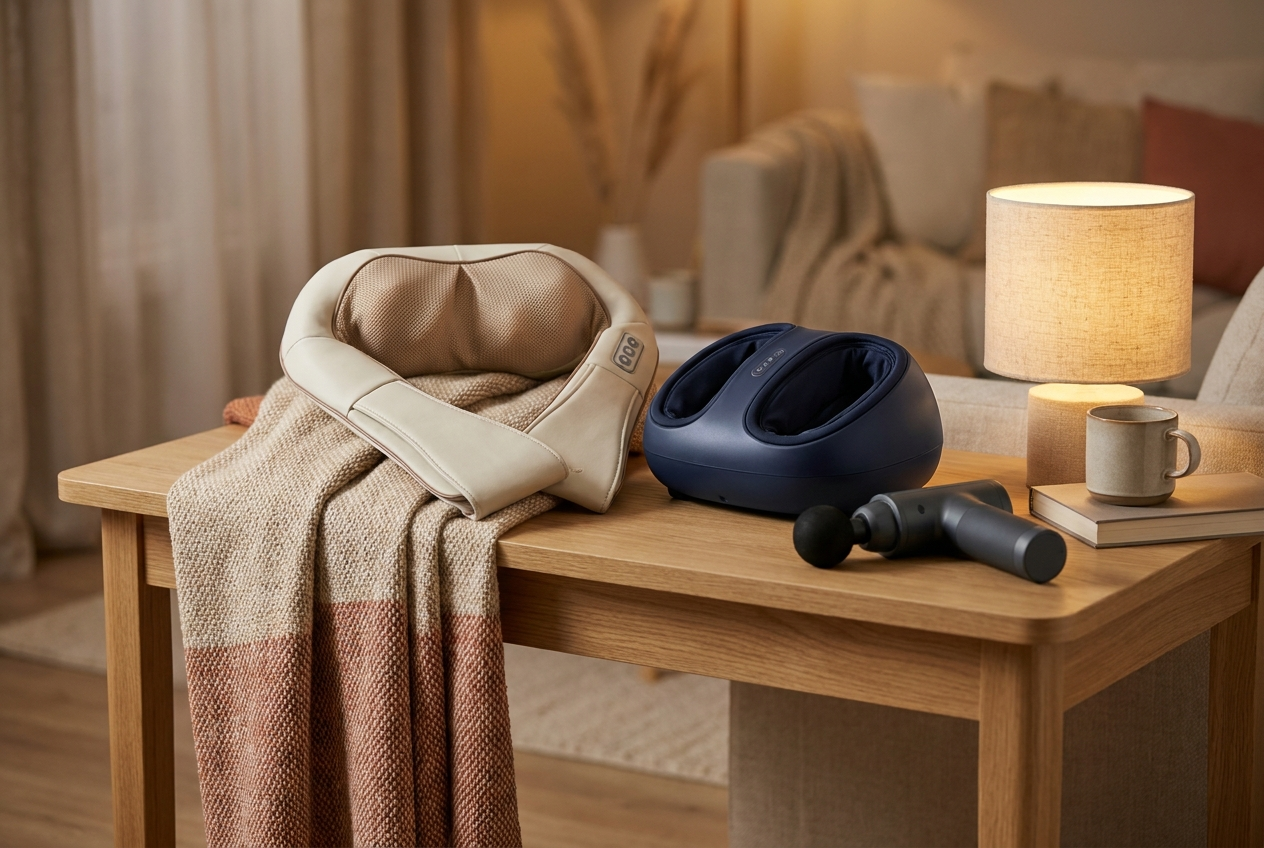
«Massager» is a single word covering profoundly different objects: a roller cushion for the neck, a gun that taps the muscle, a boot that inflates air around the calf have almost nothing in common except the general aim — a moment of comfort and relaxation at the end of the day. Choosing well means dropping the search for «the massager» and understanding which mechanism, for which area, at which moment. First an honest premise: these are wellness and comfort products, not medical devices; if you have persistent pain or particular health conditions, the right choice is to talk to a professional, not to rely on a device. That said, here is the practical framework, with a real selection from the catalogue.
1. What a massager really is
A home massager mechanically and electrically reproduces some of the gestures of manual massage: pressure, kneading, tapping, vibration, compression. It doesn’t replace a person’s hands and isn’t a clinical instrument: it’s a simple way to grant yourself a few minutes of relief after a day on your feet, at the desk, or after exercise. Keeping this expectation realistic is the first step to not being disappointed: a good massager relaxes and gives a pleasant sensation, and that is already a lot.
Perceived quality depends on three factors: intensity (adjustable or fixed), the area it’s designed for (an object shaped for the neck works badly on the feet) and ergonomics, that is how comfortable it is to position and hold in the right spot. A powerful but awkward-to-hold device is worth less than a more modest one that stays where you need it effortlessly.
There’s one last useful distinction, often overlooked: between devices that act on a precise area and devices that work over a wide area. The former — a gun, a head massager — need to be guided and are at their best if you know exactly where you need them; the latter — a seat, a band, a compression boot — wrap and relax without surgical precision, and suit general relaxation more than a specific spot. Knowing which of the two you’re after, even before the model, guides the choice more than any spec sheet.
2. The main types
Under the same label live four big mechanisms. Recognising them is half the choice.
Rotating-roller shiatsu
These are the most common: small spheres or heads that rotate, imitating the circular movement of the thumbs. They work well on neck, shoulders and back, where an enveloping, continuous pressure gives a feeling of release. A band-style shiatsu massager for neck and back is the typical example: it rests on the shoulders and works without you having to hold it.
Percussion (massage guns)
The percussion gun strikes the muscle with short, fast, repeated blows. It’s the favourite format of people who play sport and want targeted treatment on a muscle group after training. A muscle massage gun with interchangeable heads lets you vary the area and intensity; use it in moderation, as it’s the most «energetic» of the category.
Air compression
Here there are no rollers: air chambers inflate and deflate in sequence, wrapping the limb in a rhythmic pressure. It’s the typical mechanism of leg massagers, valued by those who spend many hours standing or sitting and, at day’s end, feel heavy legs and want a sense of relief.
Vibration
Vibration is the simplest, cheapest mechanism: an oscillating motor transmits a diffuse stimulation. It’s light and pleasant, suited to feet, hands and small areas, less «deep» than the others. It’s often combined with heat to increase the relaxing sensation.
3. Choose by area
The most reliable criterion isn’t power or the number of programmes, but the area you want to treat. Each part of the body has its ideal shape.
Neck and shoulders
This is where the tension of computer work builds up. Here band or cushion formats with shiatsu rollers win, adapting to the curve of the neck and freeing the hands. A 2-in-1 thermal shiatsu massager covering neck and back is a versatile choice for the evening on the sofa.
Legs and feet
For tired legs, air compression is the reference mechanism; for feet, there are dedicated devices such as a foot massager with rollers and vibration, where you rest the sole without having to bend. They’re the formats that most satisfy people who stand a lot during the day.
Head
Scalp massage has devoted fans: a head massager with silicone fingers gives an immediate feeling of relaxation and is among the simplest formats to use, even in the shower on waterproof models.
Whole body
Those seeking broader use can look at a massage seat to place on an armchair or chair: it covers back and lower back with several heads at once, and is the format closest to the idea of a «massage chair» without the bulk of one.
4. Heat: when it helps and when it doesn’t
Many massagers offer a heating function. Heat doesn’t «cure» anything, but it amplifies the sensation of relaxation and makes the massage more enveloping, especially in winter and on areas like neck and back. It’s a pleasant extra, not essential: if you live in a warm climate or mainly want a cooling effect after sport, you might prefer cold — some muscle guns offer cold heads as well as hot ones.
If you choose a model with heat, look at two things: that the temperature is moderate and, better still, adjustable, and that it switches off on its own after a while. Heat that’s too strong or without automatic shut-off is more annoying than useful. As with everything, moderation is the rule: a few minutes is more than enough.
5. Power: corded, rechargeable or batteries
Power decides where and how you’ll really use the object, and it’s underrated too often. Corded models never run out and usually have more constant power: they suit stationary use, on the sofa or armchair, near a socket. The downside is the cable, which limits freedom of movement.
Rechargeable models, increasingly common, are the right choice for those who want to move freely — a percussion gun or a head massager is at its best without a cord. Here declared battery life and the type of charging matter: a model with a USB-C port is far more convenient to top up anywhere. The few devices with disposable batteries make sense only for very small, occasional-use objects, otherwise they become a running cost.
A practical detail often decisive: if you plan to use it while travelling or at the office, a compact cordless format like a rechargeable handheld massager weighs and takes up far less than a roller device with a power adapter.
6. Materials, noise and cleaning
Three aspects you can’t see in a photo but which decide whether the object becomes a habit. Skin-contact materials should be pleasant and easy to sanitise: technical fabric and faux leather clean with a cloth, the silicone of the heads washes easily. Be wary of surfaces that hold sweat and dust and can’t be cleaned.
Noise is the most frequent surprise: some devices, especially percussion guns and cheap motors, are louder than expected. If your relaxation moment is late evening, next to someone sleeping, the sound level is a real criterion, not a detail. The best models declare quiet operation precisely for this.
Finally cleaning and upkeep: removable heads, zip-off covers and smooth surfaces make the difference over time. A massager you can’t clean ends up put away and forgotten, like any object that becomes unhygienic.
7. Common mistakes
The first mistake is buying by looking only at power. A more intense device isn’t «better»: it suits some areas and less others, and on the neck or head an excess of force is unpleasant. Intensity adjustment matters more than the maximum peak.
The second mistake is choosing a universal «whole-body» format when you actually care about a single area. An object designed specifically for the feet or the neck will almost always give a better sensation, in that area, than a generic all-rounder.
The third mistake is ignoring ergonomics. If using the device means contorting yourself or pressing it hard, you won’t use it: formats that stay in place on their own — bands, cushions, seats — win on habit. The fourth mistake is forgetting noise and battery life, the two factors that most often, in practice, send a massager to the back of the cupboard.
8. How to use it well
Even the best device only delivers if used in moderation. The simplest rule is brevity: a few minutes per area is more than enough, and short frequent sessions are more satisfying than a long intense one. Always start from the lowest intensity and go up gradually: it’s much easier to increase than to undo a massage that was too aggressive.
It’s worth choosing a fixed moment: many find it natural to use in the evening, as part of a small end-of-day ritual, perhaps paired with the heat function. Avoid using it on irritated skin, and don’t treat it as a solution to pain that won’t go away: in that case the right object isn’t a massager, but a professional’s opinion. Keeping this boundary clear is what makes the device a pleasure and not an illusion.
9. Budget: what to expect from each tier
With massagers, price mainly tells you two things: the quality of the motor and the richness of the functions. In the lowest tier you find simple vibration or roller devices, with one or two intensities: they do their job for occasional use and are a good way to find out whether you like the format, without committing too much. It’s the right tier for a first massager or a trial gift.
As the price rises, three things change: the motor becomes quieter and more constant, intensities and programmes increase, and extras appear such as heat, USB-C charging and removable covers. Not all these extras serve everyone, but the quality jump on the motor and the noise is real, and it shows above all if you’ll use the device often. Here the frequency principle applies: the more you use it, the more it makes sense to invest in a model that stands up to daily use.
The high tier, with formats like full seats or more sophisticated compression devices, makes sense for those seeking an experience close to a massage chair. Before getting there, though, ask yourself whether you’ll really use all those functions: often a mid-range model, well chosen for your area and your moment, is more satisfying than a top-of-the-range full of programmes you’ll never switch on. Here too, the balance point is almost always in the middle.
A piece of advice that cuts across all tiers: read what’s adjustable. A cheap device with adjustable intensity is often more useful than an expensive one with fixed intensity, because it lets you adapt the massage to the area and the moment. Flexibility, more than the number of preset programmes, is what makes a massager pleasant day after day.
10. Portability and habit: actually using it
The best massager is the one you use, and use depends a lot on where the device can sit without getting in the way. A compact cordless format goes in a suitcase, stays in the desk drawer, gets used on the road: it’s the right choice for those who spend many hours away from home and want a moment of relaxation elsewhere too. A larger corded format, instead, is at its best as a fixed presence in a relaxation corner, where it’s always ready to use.
The difference between a massager that gets used and one that gets forgotten often runs through this trivial detail: how easy it is to pick up and put back. A device that lives in view, within reach, gets used far more than one stored at the back of a cabinet, however better. If you want the gift to enter a habit, think from the start about where it will sit between uses.
Finally, pairing the massager with a fixed moment of the day — the evening after work, after training, before sleep — is what turns an object into a ritual. It isn’t power that creates the habit, but consistency: a few regular minutes, always at the same moment, are worth more than long, sporadic sessions. That’s how a simple device becomes part of the way you close the day.
A practical detail for travellers: check the charging type and declared battery life before leaving. A model with a USB-C port charges anywhere, even from a power bank, while one with a proprietary adapter risks staying home just when you’d need it. Portability isn’t only a matter of size, but of how independent the device is from a wall socket.
11. Quick questions
Shiatsu or percussion? Roller shiatsu is more enveloping and suited to relaxing the neck and back; percussion is more targeted and «sporty», meant for a single muscle after activity. If you want general relaxation, start with shiatsu.
Is heat essential? No, it’s a pleasant extra. It amplifies the sensation of comfort, especially in winter, but a good massager works fine without it.
Corded or rechargeable? Corded for fixed use on the sofa with constant power; rechargeable for freedom of movement, travel and office. Look at battery life and prefer USB-C charging.
How long should it be used? A few minutes per area, starting from the lowest intensity. Short regular sessions are better than a long strong one.
Can it be used every day? For comfort and relaxation use, yes, keeping to short sessions and moderate intensity. If you feel discomfort or pain, though, stop and, if needed, talk to a professional: the massager is a pleasure, not a cure.
Do I need a different massager for each area? Not necessarily. Some versatile formats cover neck, back and shoulders with a single device; for feet and legs, instead, dedicated formats almost always perform better. If you have one clear need, a specific device beats the all-rounder.
The picks
A few real devices from the catalogue, chosen to span different mechanisms and areas:
- Silax 6D Shiatsu Neck and Back Massager — the band that works hands-free
- Futsa 2-in-1 Thermal Shiatsu Massager — shiatsu with heat for the evening
- Hokgun Cold and Hot Muscle Massage Gun — targeted post-sport percussion
- Maspres Air-Compression Leg Massager — for tired legs at day’s end
- Taup Foot Massager — dedicated to the sole, no bending
- Helax Head Massager — silicone fingers, immediate relaxation
- Masseatsu Massage Seat — the massage chair, without the bulk
- Shissage Compact Shiatsu Massager — small and versatile, to keep within reach