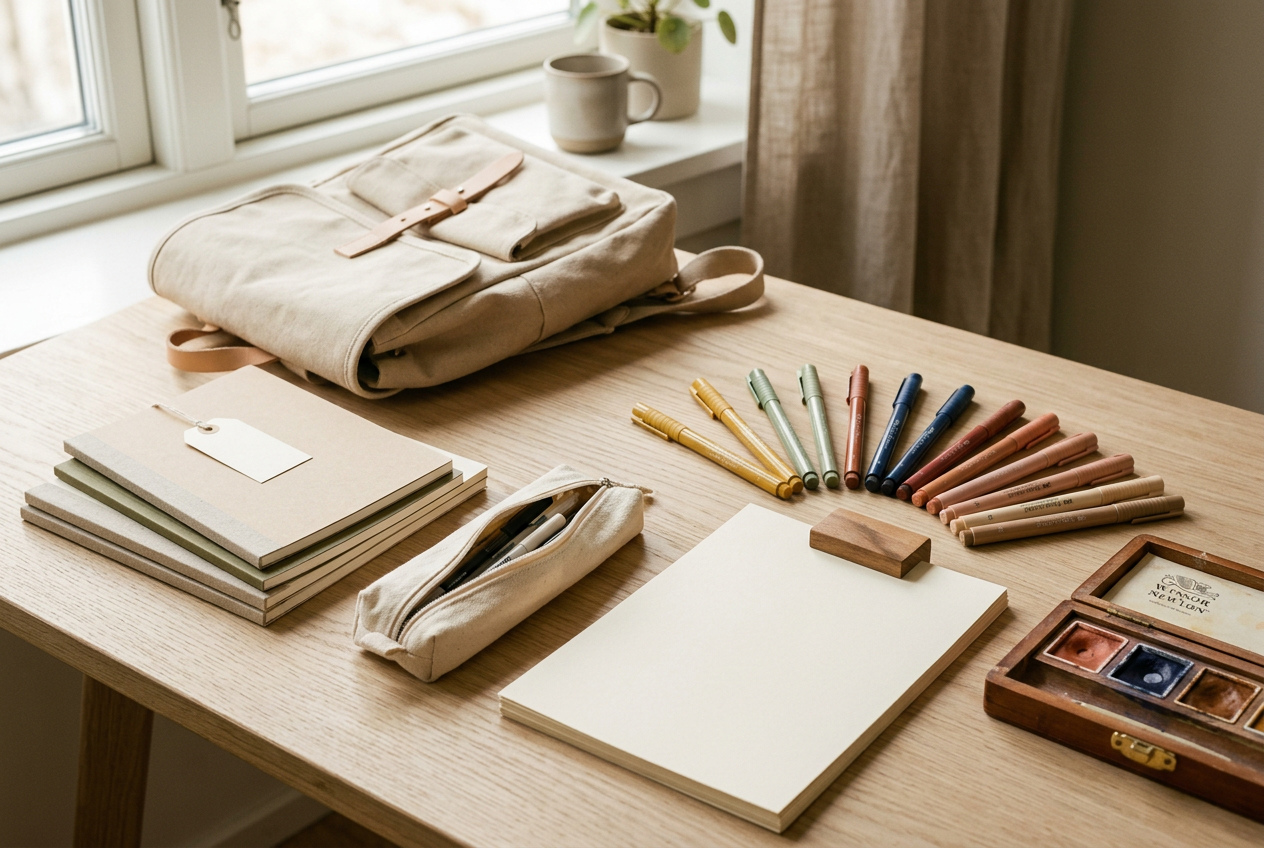
School supplies are one of the few household expenses that repeat identically every year, and one that every year gets tackled in a rush — the week before term starts, in front of a half-empty shelf, with a handwritten list that has already been lost once. We know how it ends: too much of what was already at home, too little of what will run out in November, and almost always something that is broken by Christmas. This guide is not a shopping list. It is an attempt to line up the criteria that separate a pencil case lasting three years from one lasting three months, a backpack that distributes weight from one that concentrates it where it should not go, paper suited to markers from paper that lets them bleed straight through.
1. Start with an inventory, not with a shop
The first mistake of the new school year is buying before looking. Almost every home already holds an invisible stock: notebooks started and abandoned in March, felt-tips scattered across three different cases, a ream of paper opened and half used, rulers and scissors that survive the years far better than we remember. An hour spent emptying drawers and last year's backpacks, before opening any catalogue, typically cuts a third off the list.
The method that works best is banal, and effective for exactly that reason: empty everything onto a table, split it into three piles — intact, to replace, to discard — and let only the middle pile become the shopping list. Test every pen, one by one, on a scrap sheet: it is the category where dead stock accumulates most and where people re-buy most often for no reason. Partly used notebooks should not be discarded on principle: the blank pages left can be torn out and become a supply for notes, rough drafts and exercises.
There is then a distinction worth making immediately, because it changes the budget: personal equipment versus consumables. The backpack, the pencil case, the ruler, the scissors, the calculator are objects that should last several school years; that is where spending more and choosing carefully pays off. Paper, glue, poster paints, markers and notebooks are consumables: they run out, get dirty, get lost, and should be bought on the opposite logic — sensible quantity, low unit price, easy repurchase.
2. The backpack: the piece that carries everything else
The backpack is the item chosen with the least method and the most attention to the taste of whoever will carry it. That is fine: the graphics genuinely matter, because a backpack nobody likes gets treated badly. But beneath the graphics sit three parameters that decide whether that backpack will reach June, and in what state the back carrying it will arrive.
Volume and proportion
Volume is measured in litres and should be chosen against the body, not against the number of books. An oversized backpack does not stay half empty: it gets filled. The most reliable practical rule is visual — worn on the back, the pack should neither rise above shoulder height nor drop below the hip line. Primary school generally sits between 15 and 20 litres, middle school between 20 and 30; beyond that you enter the territory of high-school models with a laptop compartment. The dimensions given in product listings, such as the classic 33 x 45 x 22 cm, are more useful than the stated volume: you can compare them directly against an A4 notebook laid alongside.
Back panel, shoulder straps, belts
The weight of a well-built backpack does not feel lighter because it weighs less: it feels lighter because it is distributed. Three elements make the difference. A padded, contoured back panel, which stops the corners of books pressing into the spine. Wide, padded, adjustable shoulder straps, which spread the load over a broad surface instead of cutting into the shoulder. And the sternum or waist strap, often ignored and in fact decisive: it shifts part of the weight from the shoulders to the pelvis and stabilises the pack while walking.
A detail that only shows up after a few months: the quality of the stitching where the shoulder straps attach. That is where cheap backpacks give way, almost always by the second term, when the winter load peaks. It is worth checking at the moment of purchase, by pulling the strap firmly downwards.
When a trolley makes sense
The school trolley — a backpack with wheels and a telescopic handle, like the Safta 6 backpack trolley — solves a real problem: the daily load over long, flat routes. It works well when the home-to-school journey is on asphalt or even pavement with no stairs. It works badly with steps, gravel, snow or crowded buses, where the trolley becomes one more thing to lift by hand, often in a worse posture than a pack on the shoulders. Before choosing one, walk the real route mentally, not the ideal one.
3. Writing: pens, pencils, markers
The category with the lowest cost per item is also the one with the most waste. The reason is that it gets bought sight unseen, in multipacks, without knowing whether that tip writes well on that paper and without distinguishing between different uses that call for different tools.
Pens and pencils: longevity over brand
For everyday writing the criteria are consistent flow and the availability of refills. A refillable pen costs more upfront and far less over three years, and it visibly reduces waste. For pencils, the grade matters more than people think: HB is the universal compromise, 2B is softer and suited to drawing, H is harder and more precise for technical drawing and geometry. Buying only HB and then complaining that geometry work comes out smudged is a classic.
Markers: permanent, highlighters, fine liners
Three families are worth separating. Permanent markers, like the Stanley black permanent marker in a two-pack, are for labelling, marking folders and writing on plastic and non-porous surfaces: they dry fast and do not smudge, but they go through thin paper. Highlighters should be water-based so they do not dissolve the printed ink underneath. Water-based fine liners, like the Alex Bog Outliner set of 12, are the right tool for concept maps, diagrams and colour-coded notes: they draw thin, do not bleed through and wash out of fabric far more easily than permanents.
One practical note that solves half the problems: water-based markers should be stored horizontally, permanent ones tip down. Stored the other way round, the first dry out at the tip and the second flood. It is a trivial detail that extends the useful life of a whole set.
4. Paper and notebooks: formats, weights, rulings
Paper is the most predictable consumable and the easiest one to save on properly, because the unit price collapses with quantity and the product does not deteriorate if kept dry. A Michel A4 ream of 100 sheets kept at home covers printouts, exercises and rough drafts for months, and removes the evening dash to a closed stationer.
Paper weight, the number nobody checks
Packs carry a number followed by gsm. It is the weight of the paper and it determines how opaque it is and how well it holds ink. Below 70 gsm paper is cheap but see-through: markers bleed to the other side and double-sided printing becomes unreadable. 80 gsm is the sensible standard for school and home use. Above 90 gsm you enter drawing and presentation paper, where the extra body genuinely helps. Choosing 80 over 65 costs almost nothing and settles the double-sided problem once and for all.
Notebook rulings and formats
A4 is now the standard for middle and high school because it lines up with photocopies and printouts; the smaller A5 remains handy as a planner, a language notebook or a logbook. The A5 ring binder notebook with pen is a good example of a pocket format for daily notes. On ruling the rule is simple: lines for text, 5 mm squares for maths and science up to middle school, 4 mm squares when more density is needed, blank pages for drawing and maps. It is worth checking the teacher's specific request before buying twelve notebooks of the same ruling.
One tip that applies to every format: prefer hard or laminated covers for the subjects carried every day, and light covers for the ones that stay at home. The cover is the part that fails first, and protecting it costs less than replacing the whole notebook.
5. Colour and art: paints, watercolours, pads
The art section is where buying goes worst, because it is hard to judge performance without trying. Three criteria help.
The first is coverage: a decent poster paint covers the sheet in a single pass and does not let the pencil line show through underneath. Single 120 ml bottles, like the Pincello light blue poster paint, make sense when you need a few base colours in quantity; multipacks, like the Pincello neon poster paints in a pack of 12, pay off for group work and workshops where consumption is high and unpredictable.
The second is watercolour pigmentation. A cheap watercolour pan releases a lot of colour on the first pass and then runs dry; a good one stays stable. A broad set such as the 21-piece watercolour set has the practical advantage of covering most school requirements without having to mix intermediate shades — which, for younger children, is usually the point where the work gets messy.
The third is the surface. Painting with water on photocopy paper is the number one reason drawings buckle and tear. You need a pad with adequate weight: a Pacsa drawing pad, 20 sheets 33 x 23 cm with frame holds light watercolour and poster paint without warping, and the pre-printed frame solves the cosmetic problem of ragged edges. It is worth keeping a spare: art homework almost always arrives at short notice.
6. Organising and labelling: the part nobody buys and everyone regrets
Supplies that get lost are supplies that get bought again. In primary and middle schools the share of items mislaid over a year is high, and it almost always involves unidentifiable pieces. A pack of 450 adhesive labels costs less than a single pen and repays its price many times over in a year: they go on pencil cases, rulers, water bottles, calculators, notebook covers. The rectangular self-adhesive labels, 168 pieces work well on binder spines, where a more legible surface is needed.
On the pencil case, the criterion that matters most is internal separation. A single-compartment case becomes, within weeks, a container in which nothing can be found and in which tips ruin each other; one with elastics or dividers keeps an order its owner can rebuild in three seconds. The material matters too: technical fabric wipes clean with a damp cloth, coated cardboard falls apart at the first accident with a water bottle. Rigid containers such as the round Minecraft case, 8 x 22 x 8 cm have the advantage of protecting tips and standing upright on a desk, which reduces spills.
A third level of organisation, often forgotten: the station at home. A fixed container to which scissors, glue, ruler and refills return every evening prevents the evening search and cuts duplicate purchases. No furniture required: a box and the rule that the box does not move is enough.
7. Five common mistakes that cost twice
Buying everything before day one. Many specific requests — rulings, formats, cover colours, tools for particular subjects — come from teachers in the first week. Buying the complete set in advance almost always means buying something twice. The better strategy is to cover the certain essentials immediately (backpack, pencil case, paper, pens) and wait a week for the rest.
Choosing the backpack on graphics alone. The graphics deserve respect, but within the range of models a child will accept there are enormous differences in back panel and straps. The compromise works: choose together, but rule out unpadded models from the start.
Underestimating consumable quantities. Glue, paper and pencil leads run out in mid-November and get re-bought at the worst price, in a hurry. A considered stock bought in August costs less and removes a source of stress.
Buying huge colour sets. Packs of 48 felt-tips look like a bargain, but the colours actually used are always the same twelve; the rest dry up untouched. Better a medium set of higher quality, plus repurchasing the individual colours that run out.
Ignoring total weight. The daily load builds up from items that individually feel light. Weighing the full backpack once, in the first week, is an exercise that often leads to taking something out and leaving at home whatever is needed once a week.
8. Maintenance: making supplies reach June
Almost everything that breaks during the year breaks from a lack of minimal maintenance, not from a defect. The backpack should be emptied completely once a month: crumbs, sand and open pens at the bottom are the most frequent cause of permanent stains and jammed zips. Zips clean up with a dry brush and, if they stick, can be lubricated by running a graphite pencil along the teeth — an old remedy that works perfectly.
Technical backpack fabrics should be hand-washed in lukewarm water with neutral soap, never in a machine at high temperature: heat unglues the padding and deforms the contoured back panel. Poster paints require the cap to be genuinely closed and the bottle kept upright; paint that has dried on the surface can often be recovered with a few drops of water and a stir, so it is worth trying before throwing it out. Watercolours should be wiped with a damp cloth at the end of a session so the colours do not contaminate one another.
Finally, notebooks: corners wear because the notebook travels loose in the backpack. A rigid binder or a simple folder solves the problem, and costs less than replacing the notebook halfway through the year.
9. Seasonality: when to buy what
Demand for school supplies concentrates in two peaks — late August and early January — and the two moments follow different logics. August is the time for durable pieces: backpack, pencil case, containers, drawing tools. That is when the range is widest and when you find the right size or model instead of settling for what is left.
Consumables, by contrast, are better bought in stages. A first stock in August, a second in mid-October once you know what actually gets used, and a top-up in January for the second half of the year. This avoids both the November scramble and the pile of material that stays shut in a cupboard.
There is then a window often overlooked: the months between April and June, when demand falls and current-year items remain available. It is the best moment to buy non-perishable consumables — paper, notebooks, glue, leads — and set them aside for the following autumn. It takes a minimum of planning, but it is the choice that reduces total spending most.
The selection
A considered selection from the Dedalshop School Supplies category, chosen to cover the different uses discussed above — carrying, writing, paper, colour, organisation.
- Barbie Painterly school backpack, 33 x 45 x 22 cm — full size for A4 notebooks, with stated dimensions you can check against real contents.
- Safta 6 backpack trolley, 30 x 85 x 23 cm — the wheeled solution for long, flat routes.
- Pincello labels, 450 labels in 5 packs — the smallest outlay with the highest return over a school year.
- Alex Bog Outliner marker set, 12 pieces — water-based fine liners for diagrams, maps and colour-coded notes.
- Stanley black permanent marker, 2 pieces — for labelling folders, containers and non-porous surfaces.
- Pacsa drawing pad, 20 sheets 33 x 23 cm with frame — weight suited to light watercolour and poster paint.
- Watercolours, 21-piece set — broad palette coverage without mixing intermediate shades.
- Michel A4 paper, 100 sheets — the home stock that prevents the evening dash to the stationer.
- A5 ring binder notebook with pen — pocket format for languages, planning and daily notes.
- Round Minecraft case, 8 x 22 x 8 cm — a rigid container that protects tips and stands upright on a desk.
Mini-FAQ
How much should a full backpack weigh?
There is no single regulatory threshold, but the most widely cited guidance suggests staying around 10-15% of the carrier's body weight. The practical way to check is to weigh the loaded pack in the first week and, if the number is high, review what is carried every day versus what is actually needed.
Backpack or trolley?
It depends on the route, not the age. A trolley pays off on long, flat journeys with no stairs; a backpack with a padded back panel and sternum strap stays more versatile wherever there are steps, public transport or uneven ground.
Which paper weight should I choose?
80 gsm is the sensible school standard: opaque enough for double-sided work and markers, cheap enough for daily use. Below 70 the paper becomes see-through; above 90 only makes sense for drawing and presentations.
Is it worth buying everything in August?
It is worth buying the durable pieces in August — backpack, pencil case, containers, tools — when the range is at its widest. For consumables, a first stock in August plus staged top-ups in October and January works better, once you have seen what actually gets used.