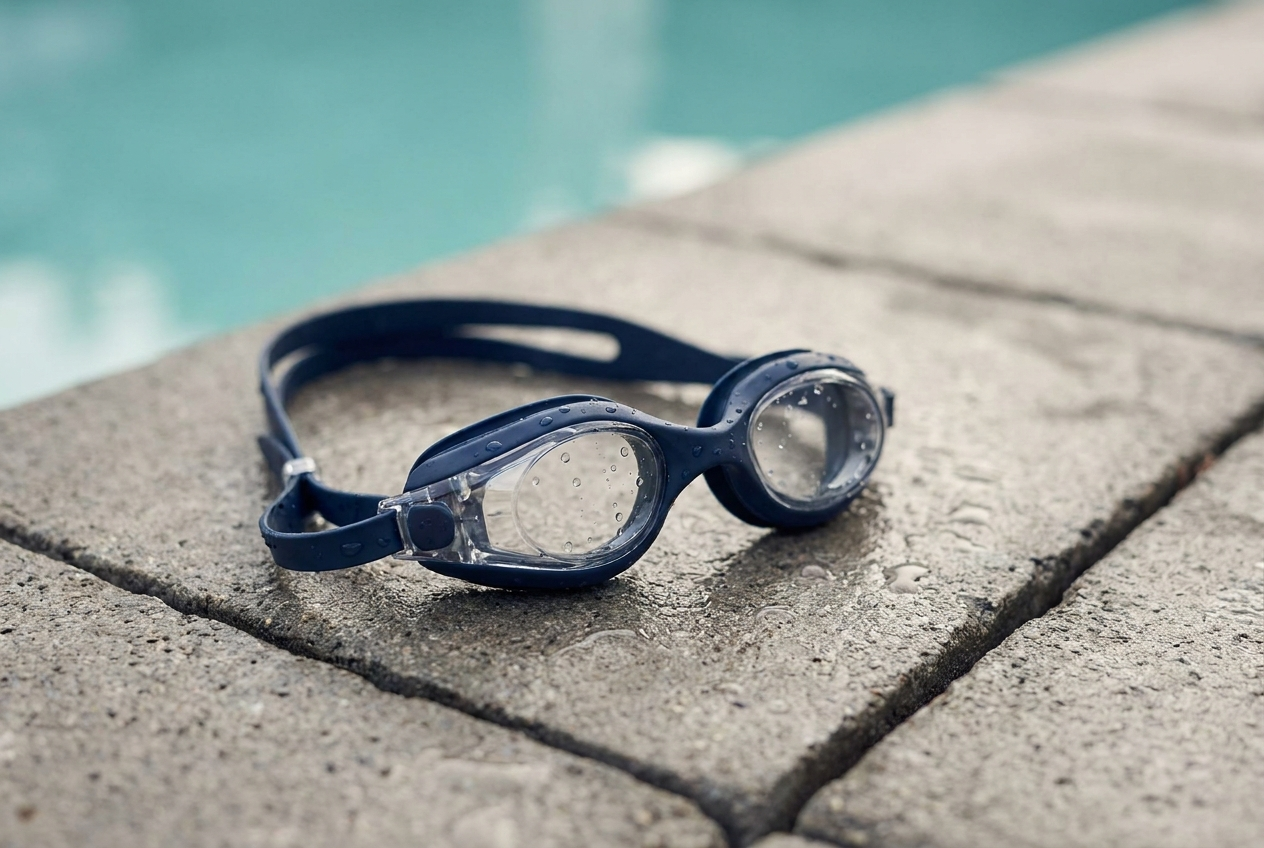
Swimming goggles look like the most trivial item in the pool bag, and that is exactly why they are so often chosen badly. People go by colour, by the lowest price, by whatever was on the shelf the day before the seaside trip. Then comes the moment of truth in the water: the seal lets water in, fog wipes out the lane, the strap pinches above the ears, and after ten minutes the thing ends up on the pool edge. This guide lines up the criteria that actually matter after the first week of use — seal, lenses, anti-fog, sizing, environment — because a well-chosen pair you barely feel, and a badly chosen one ruins every stroke. No useless jargon: only what you need to get it right, with concrete examples and a real selection from the Dedalshop catalogue.
1. The seal comes before everything
The first criterion is not the lens, it is the gasket: that soft frame that rests around the eye and creates the suction that keeps water out. If the seal does not work, no mirrored or anti-fog lens will save the experience. Goggles that leak force you to stop, empty them, reposition them — and at that point you might as well not wear them at all.
The seal depends on two things: the gasket material and the shape of the eye socket. The best materials are soft silicone and thermoplastic rubbers, which adapt to the skin and recover their shape after being compressed. Foam gaskets, typical of very cheap models, hold less over time: they absorb water, compress and stop sealing after a few outings. Shape, on the other hand, is personal: every face has a different socket, and goggles that seal perfectly on one person may leak on another. That is why trying them — even just pressing the gasket against the eye without the strap and checking that it stays put for a couple of seconds thanks to the light suction — is worth more than any spec sheet.
A detail almost nobody considers: a seal is not achieved by tightening more. If you have to pull the strap to the maximum to keep water out, the gasket is not right for your face. Correct goggles seal with moderate tension; the strap only holds them in place, it does not press them against your face. Over-tightening leaves red marks around the eyes, causes headaches and, paradoxically, can deform the gasket until it leaks.
2. Lenses: clear, tinted or mirrored
The lens decides how much and how well you see underwater, and the choice depends almost entirely on where you swim. There is no absolute best lens: there is the right one for your light.
Clear lenses
They are the most versatile choice and the best for indoor pools and for anyone swimming in the evening or in dim environments. They let through the maximum amount of light, return true colours and do not make you lose detail when lighting is poor. If you mostly swim indoors, start here.
Tinted lenses (smoke, amber, blue)
Dark or smoked lenses reduce glare and are comfortable outdoors on bright days. Amber or orange tones increase contrast when the light is flat or overcast, useful in an outdoor pool on grey days. It is the middle ground for anyone alternating indoors and outdoors without wanting to buy two pairs.
Mirrored lenses
They are designed for strong sun: the mirror surface reflects part of the light and noticeably reduces glare in an open-air pool, at the sea, in open water at midday. Indoors, however, they tend to darken the scene too much. They are the summer choice par excellence, but not the single lens for the whole year.
One aspect linked to the lens is UV protection. Many outdoor goggles claim a UV filter: it is a detail that matters if you spend hours in the water under the sun, because the eyes, like the skin, suffer from exposure. It is not a requirement for those who only swim in a covered pool, but it becomes relevant for the sea and open-air pools in high summer.
3. Anti-fog: what works and what does not
Fogging is the flaw that makes people abandon more goggles than any other. It happens because body heat warms the inside of the lens while the water cools it on the outside: condensation forms and the lane disappears. Almost all goggles come with an anti-fog treatment applied to the inner face of the lens, and as long as that treatment lasts they work well. The problem is that the coating is delicate and wears off: every time you run a finger over the inside of the lens to dry it, you damage it a little.
The first rule, then, is counter-intuitive: never touch the inside of the lens. After use, rinse with fresh water and let it air-dry, without rubbing. That way the original treatment lasts much longer. When it starts to fail — usually after a few months of regular use — you can fall back on the old tricks: a few drops of a dedicated anti-fog solution, or the home remedy of a drop of heavily diluted detergent applied gently and rinsed off. They are temporary solutions, but they extend the life of the goggles.
Be wary of promises of eternal anti-fog: no treatment is permanent. Good goggles are those whose coating starts effective and lasts a whole season if treated with care, not those that promise never to fog up. Maintenance makes more difference than the model.
4. Size and fit: child, teen, adult
Size is where people go wrong most often, especially when buying online. Adult goggles on a small face never seal, however much you tighten them; child goggles on an adult let water in constantly. Many models indicate an age range or even a weight range — useful above all for the youngest — precisely to help choose the right size.
For adults, the distance between the eye sockets matters a lot: some goggles have a fixed nose bridge, others adjustable or with interchangeable pieces. The adjustable bridge is more forgiving of different face shapes and is the safest choice when you cannot try them first. For children, on the other hand, the priority is simplicity: an easy-to-adjust strap and a soft gasket that leaves no marks matter more than any advanced feature, because the goal is for the child to stay happily in the water, not to fight the equipment.
The strap deserves one last note. Double silicone straps, which split in two behind the head, distribute tension better and stay in place more than flat single straps. For children, models with a quick-buckle adjustment are the most practical, because they adapt in a single gesture, even with wet hands.
5. Where you swim changes everything
The criterion that sums up all the others is the environment. Choose first where you will use the goggles, and the lens, the colour and even the seal almost choose themselves.
Indoor pool. It is the most regular environment: constant artificial light, chlorinated water, no sun. Here the clear or lightly tinted lens wins, and the durability of the anti-fog treatment and the gasket's chlorine tolerance matter a lot. Chlorine, over time, hardens lower-quality rubber: good silicone resists, poor silicone stiffens and loses its seal.
Outdoor pool and sea in summer. Here glare and UV rays come into play. A mirrored or dark lens, a UV filter if you spend many hours in the water, and a gasket that holds even with sunscreen around the eyes — a detail often underestimated, because the oil of the sunscreen reduces adhesion. Rinsing your face before putting them on helps.
Sea and open water. Beyond the dark lens, the field of vision matters: goggles with wider or slightly curved lenses give better lateral vision, useful where there are no lanes to follow. The seal becomes even more important, because the wave motion tests the gasket more than the still pool does.
Seasonality, in this sense, is concrete. In summer demand shifts towards dark and mirrored lenses and towards children's sizes, because it is the season of the sea and family holidays. Taking it into account means buying at the right moment what you will actually use in the following months, instead of ending up with the wrong lens for the light in front of you.
6. The most common mistakes
The first mistake is buying by price alone. Goggles costing a few cents are fine for occasional play on holiday, but if you swim regularly the difference between a poor gasket and a good one shows from the first week. You do not need to spend much — good goggles cost little — but you do need to look at the material, not just the tag.
The second mistake is tightening the strap to compensate for an imperfect seal. As we saw, it is the symptom of a wrong size or shape, not the solution. The third is drying the inside of the lens with a finger or a towel, destroying the anti-fog treatment within a few outings. The fourth is leaving them in the bag, piled up with keys and sunscreen, where the lens gets scratched and the case — if there is one — is never used.
Then there is a mistake of expectation: thinking that goggles solve everything. They do not correct vision (for that there are specific prescription models), they do not entirely prevent fogging in extreme conditions, they do not last forever. They are a simple accessory that, chosen well and treated with care, does exactly its job and is forgotten — which is the highest compliment for an object like this.
7. Maintenance: making them last a season and beyond
Goggle care is trivial but decisive, and it pays back in months of extra life. After every use, rinse them with fresh water: chlorine and salt are the two main enemies, because they attack the rubber and cloud the lenses. A few seconds under the tap, without soap, are enough to remove most residue.
Never rub the inside of the lens, as said, and let them air-dry in a shaded spot: direct sun and the heat of a car dashboard are among the most frequent causes of gasket deformation. Store them in their rigid case if they have one, or at least apart from sharp objects. If the strap loses elasticity or breaks, many models allow it to be replaced, extending the life of the goggles instead of throwing them away.
One last tip concerns children: teaching them from the start to rinse and set down the goggles, instead of throwing them into the bag, is the best way to avoid buying new ones every summer. It is also a small lesson in caring for objects that is worth more than the saving.
8. Goggles for the youngest
With children the goal changes: it is not performance, it is getting used to the water. Goggles that bother them, pinch or leave marks become the perfect excuse not to want to wear them. That is why, for the youngest, three things matter above all: a soft, wide gasket that does not press on the eyes, a very easy-to-adjust strap, and a correct size, often indicated by age range or weight.
Colour, which is secondary for an adult, is almost a criterion for a child: goggles they like they wear more willingly, and that, in practice, counts. Safety lies in never tightening too much and in checking that the gasket does not leave deep marks after use; if it does, the size is wrong. No advanced feature beats a child who stays happily in the water with their eyes open underwater without stinging.
9. Goggles and vision: when the lens is not enough
Anyone who wears glasses faces a concrete problem: underwater, without correction, the lane and the pool edge become a blurred smudge. There are three solutions, each with its trade-offs. The first is to wear contact lenses under well-sealed ordinary goggles: it works, but with the risk of losing a lens if water gets in, which is why it is best to keep your eyes closed whenever you remove the goggles. The second is prescription goggles, sold with a standard short-sight correction: they do not replace a specialist eye test, but for many they are an enormous convenience compared with swimming blind. The third, for those with particular needs, are made-to-measure models, more expensive and niche.
The practical point is not to overlook the matter: swimming without seeing well is not just uncomfortable, it is also less safe, especially in open water or crowded pools where recognising other swimmers counts. If vision is an issue, put it among the criteria from the start, even before the lens colour. It is worth remembering that prescription goggles and mirrored lenses are not mutually exclusive: there are combinations designed for those who want correction and sun protection together. But it is a purchase to make with a clear idea of your main use, because every extra feature is also a trade-off in terms of versatility and price.
A similar point applies to those who complain of red, irritated eyes after the pool. Often it does not depend on the chlorine itself, but on goggles that let water in with every stroke. A gasket that really holds is, in this sense, also a form of comfort for the eyes: it reduces contact with the treated water and makes the pool session less tiring. It is not a medical device and cures nothing, but goggles that seal well remain the first, simple barrier between the eye and the water — another reason why, as we said at the start, the seal comes before everything.
The selection
A real selection from the Dedalshop catalogue, from holiday play to regular swimming, designed to cover the most common sizes and uses:
- Bestway Adult Swimming Goggles with silicone strap — a versatile adult pair, adjustable silicone strap, a good starting point for the pool.
- Bestway anti-fog silicone swimming goggles for adults — soft silicone and anti-fog treatment, for those who swim regularly.
- Bestway Swimming Goggles Pink (S/M, 11-19 kg) — size indicated by weight, ideal for the youngest.
- Bestway Swimming Goggles Red (S/M, 11-19 kg) — the same junior size in a different colour.
- Bestway Children's Swimming Goggles Pink — a simple model to adjust, made for getting used to the water.
- Intex Children's Swimming Goggles White — essential and cheap, perfect for occasional play on holiday.
Mini-FAQ
Why do my goggles fog up straight away?
Almost always because the internal anti-fog treatment has worn off, often from drying the lens with your fingers. Rinse with fresh water without rubbing the inside; when the coating fails, use a drop of anti-fog solution or heavily diluted detergent.
How do I work out the right size without trying them?
For children, rely on the age or weight indications. For adults, prefer an adjustable nose bridge: it tolerates differences in face shape better when you cannot try them first.
Clear or dark lens?
Clear for the indoor pool and the evening; dark or mirrored for strong sun in an outdoor pool and at the sea. If you alternate, a lightly tinted lens is the best compromise.
How long do they last?
With care — a fresh-water rinse, no direct sun, a rigid case — good goggles easily last a whole season and often much longer.