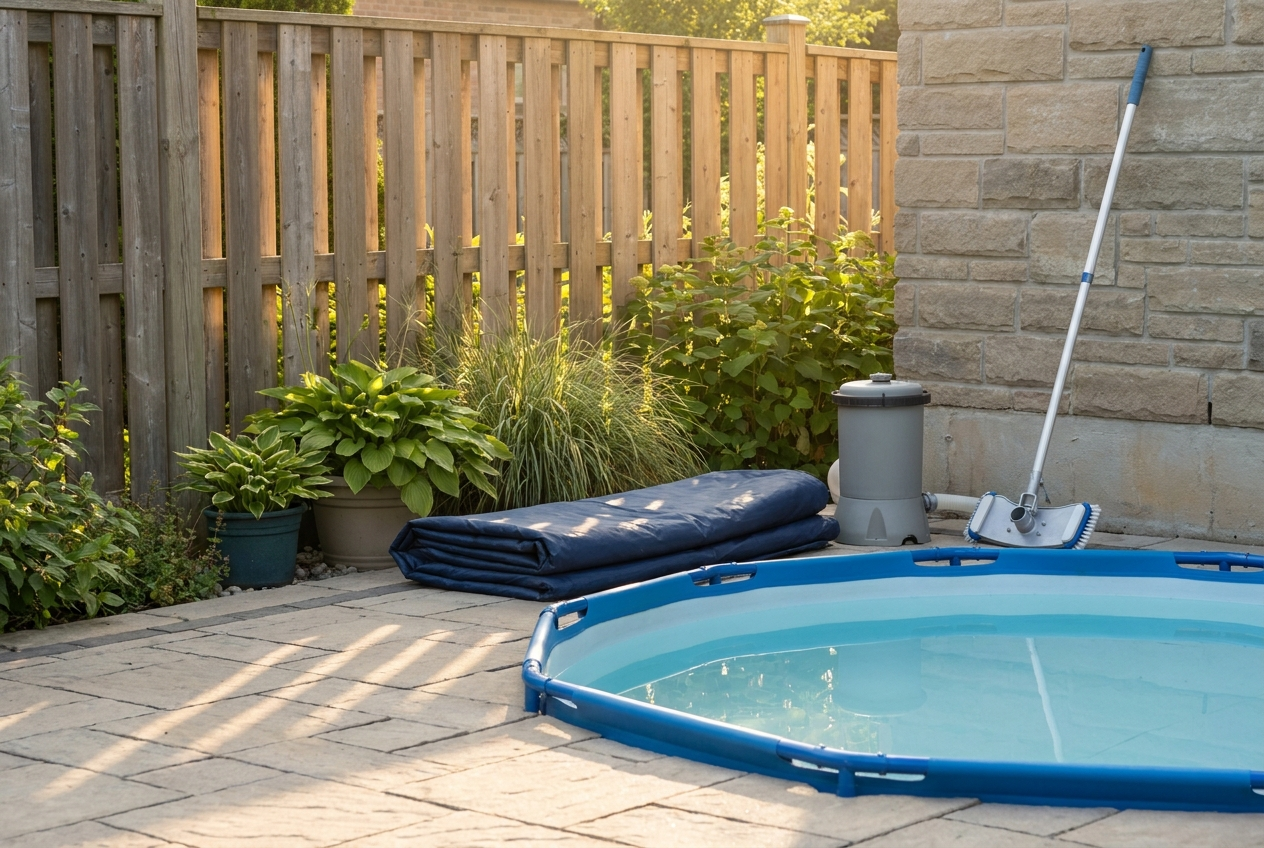
The above-ground pool is one of the most misunderstood purchases of the summer. You look at the price, you look at the centimetres, you order — and three weeks later the water is green, the grass underneath is dead and nobody wants to get in any more. The problem is almost never the pool: it is that the format chosen demands more maintenance than anyone felt like doing, or that the boring step was skipped — preparing the ground it sits on. This guide puts the questions in the right order: how much pool you actually need, which format supports that need, what to do before filling it, how much work it asks each week, and how to close it in September without throwing it away. No promises of self-cleaning pools: they do not exist.
1. The first question is not which pool, but how many hours in the water
Before looking at any spec sheet, answer a concrete question: realistically, how often will this water be used? The answer changes everything, because each format carries a hidden cost in time and attention, and that cost is paid all season, not just on assembly day.
The occasional cool-down
Small children, half an hour in the afternoon, three or four times a week, shallow water emptied and refilled often. Here an inflatable or rigid tub 30-45 cm high is the right choice, and filtration is unnecessary: you change the water. Buying a frame pool for this use means paying for a structure, a pump and two hours of assembly for a need that does not require them.
The daily family swim
Adults who actually get in, near-daily use from June to September, water that stays for weeks. Here volume matters and changing the water is no longer a solution: you need a filtration system, a minimum of chemical management and a properly prepared base, because a full structure is heavy and unforgiving of uneven ground.
The middle way
A self-supporting or ring-top inflatable pool 180-200 cm across with 50 cm of water is the most common compromise: it fits a wide balcony or a patch of garden, fills in half an hour, empties without drama and holds an afternoon for two. It is not a swimming pool, and it is fair to know that beforehand.
2. The real formats, without the marketing
Under the word "pool" the catalogue places very different objects. Telling them apart is half the work.
Ring inflatable
The walls are air rings that rise as the tub fills. Ten-minute assembly, negligible weight, low price. In exchange: the wall is soft, so the rim deforms if you lean on it, and the top ring takes the sun and degrades first. Perfect for children and shallow depths, less suited to anyone who wants to leave it up for three months.
Rigid or semi-rigid
Preformed PVC walls that stand on their own, often with a star base on small models. Nothing to inflate, no rings, just fill it. It is the most practical solution for baby formats: empty and tip it in ten seconds, dry it, put it away.
Self-supporting with a top ring
A single inflatable ring at the top, the rest of the wall held up by water pressure. Diameters up to a good two metres, heights around 50 cm. A good ratio of volume to simplicity, but be careful: it needs a genuinely level surface underneath, because the water line is merciless at showing a slope.
Demountable frame
Metal tube structure with a reinforced PVC liner. It is the only format that truly stands up to daily family use, and the only one worth pairing with a filtration system. In exchange it asks for two people and an afternoon to assemble, a seriously prepared base and a weekly maintenance routine. It is a small piece of infrastructure, not a toy.
3. The spot comes before the pool
This is the step everyone skips and the one that decides whether the pool lasts one season or five. A thousand litres of water weigh a tonne: any pebble, root or dip under the base becomes a permanent point of stress.
Level ground
The base must be flat. Not "nearly flat": flat. On a two-metre tub, two centimetres of slope translate into a visible difference in water level and a wall working crooked all summer. A spirit level on a long board, before filling, costs five minutes and saves the structure. And never correct a slope by adding soil or sand on one side under an already assembled tub: you create a collapse point.
What is underneath
Very short-cut grass, or levelled and compacted gravel, or paving. In every case you need a protective layer between ground and base: interlocking foam tiles or a technical groundsheet. It does two things: protects the liner from punctures from below and insulates a little from cold ground. On grass, know that the lawn under the pool dies within days; if that is a problem, choose another spot.
Sun, wind, trees
Direct sun for a good part of the day: the water warms up for free. But sitting under a tree is the worst possible choice — leaves, resin, pollen and insects end up in the water every day and filtration cannot keep up. And plan a shaded spot nearby, not overhead: people spend more time around the pool than in it.
The water that comes out
Before filling, ask where that water will go when you empty it. A thousand or ten thousand litres heading towards a patio door, a wall or the neighbour's vegetable patch is a serious problem. You need a natural slope leading elsewhere, or a hose long enough to control the discharge.
4. Water: change it, filter it, or both
This is where you decide whether the water will be clear in August or green. The rule is simple: either you change the water often, or you filter and treat it. There is no third way.
Under 1000 litres: change it
In shallow children's tubs the most hygienic and simplest strategy is to empty and refill. Every two or three days, while the water is still clear. A cover overnight reduces what falls in and lets you stretch the interval a little. No chemicals, no pump.
Over 1000 litres: filter it
Above that, changing the water becomes unsustainable — in cost, in time and in waste. You need a cartridge pump sized to the volume. The practical criterion is turnover: all the water in the tub should pass through the filter at least twice in twenty-four hours, which for an average tub means running the pump between six and eight hours a day, preferably during the hottest and busiest hours.
Cartridges are a consumable
This is by far the most widespread mistake: treating the cartridge as a permanent part. It is not. Rinse it under a jet of water every two or three days and replace it every two to four weeks of real use, sooner if the water is hard or the pool is near plants. A clogged cartridge does not filter: it just moves water around while the pump strains. Keep a spare and rotate two, so one dries while the other works.
Chemistry: little, but regular
Family tubs need two things and no more: a slow-release disinfectant in a floating dispenser and a periodic pH check. pH out of range makes the disinfectant nearly useless — which is why sometimes you add chlorine and the water stays cloudy anyway. Better to measure twice a week with test strips than to add product by eye. And always pour product into water, never the other way round, with the pump running and nobody in the pool.
5. The weekly routine, concretely
A well-run above-ground pool asks for roughly twenty minutes a week, spread out. It is worth writing them down, because it is the part nobody mentions at the point of purchase.
Every day, one minute
Surface net for leaves and insects before they sink. Once on the bottom, the same leaves become a much longer job and stain the liner.
Twice a week, five minutes
Bottom vacuum, working from the edge towards the centre with slow movements — too fast and you lift the sediment instead of collecting it. A manual vacuum connected to the garden hose is enough for above-ground tubs and costs a fraction of a robot. Check the pH with strips at the same time.
Every two or three days, three minutes
Rinse the cartridge. And wipe the waterline with a cloth or soft sponge, where the ring of dirt and sunscreen builds up: removed straight away it comes off with water, left for two weeks it needs scrubbing and marks the liner.
Once a week, five minutes
Top up the level — summer evaporation loses more water than you would think, and a low level makes the skimmer suck air — and visually check the fittings and structural joints.
6. Safety: the part you cannot buy
This must be said plainly, because it is the one chapter with no room for improvisation. No accessory, no armband and no cover replaces the direct, continuous supervision of an adult when there are children in or near the water. Even a few centimetres of depth are enough to create a dangerous situation, and it happens silently and in moments.
The practical rules that reduce risk are few and all of them matter. Empty shallow tubs completely when not in use, do not just cover them. Cover large ones with a taut, secured sheet, never half-laid — a slack cover is more dangerous than none. Remove the ladder when the pool is unsupervised, so access is not trivial. Never leave floating toys in the water at the end of the day, because they invite a return. Keep the pump, extension leads and sockets away from the edge and protected, and never touch them with wet hands. And set one simple, non-negotiable family rule: in the water only with an adult present, always.
7. The recurring mistakes
They are the same ones, year after year.
Filling before levelling. Once a thousand litres are in, nothing can be corrected except by emptying it all. Five minutes with a spirit level are worth a season.
Buying bigger than you can manage. Volume grows much faster than diameter: going from 180 to 300 cm does not double the work, it triples it, across filling, filtration and products.
Setting up on grass without protection underneath. A dry blade of grass or an invisible pebble is enough to puncture the base after a few weeks of weight and movement.
Treating the cartridge as eternal. See above: it is the single most common cause of cloudy water.
Leaving the cover resting on the water instead of taut. It becomes a trap, collects rainwater and gets dirty underneath.
Over-inflating the top ring during the hottest hours. PVC expands in the sun: inflating it rock-hard at midday puts it under tension. Better to inflate in the morning, firm but yielding to thumb pressure.
Folding and storing the liner damp. It is the best way to find it mouldy and stained the following spring.
8. Seasonality: April, July, September
An above-ground pool has three different moments, and treating them the same way is a mistake.
Setting up
From mid-May onwards at our latitudes, once the nights stop dropping too far. Setting up early means heating water nobody will use for weeks and giving algae time to start. Assemble on a windless day — a liner spread in the wind is unmanageable — and leave the sheet in the sun for an hour before opening it, so the PVC softens and lies flat without creases.
Peak season
July and August are the months when the routine must be kept consistently, because high temperatures and intensive use accelerate everything: warm water consumes disinfectant much faster and the organic load from creams and sweat is at its highest. It is also when the cover makes the biggest difference: used at night it reduces evaporation, holds a few degrees and keeps most of the dirt out.
Closing
Do not wait for the cold. Empty it with the pump or by gravity, rinse the liner with clean water, let it dry completely in the sun on both sides — completely is the key word — and fold it without crushing the corners. Spent cartridges out, good cartridges dried and stored dry. The metal structure gets dried and stored under cover, not in a corner of the garden under a sheet. A pool put away well restarts the following year in half an hour; one put away badly gets bought again.
9. Quick comparison: which format for whom
Rigid or shallow inflatable tub, up to 45 cm. For small children, occasional use, tight spaces. No filtration, frequent water changes, daily emptying. The lowest possible commitment.
Inflatable with a roof or sunshade. Same category, but designed for the months when the sun is strong and the children are very young: built-in shade avoids setting up a parasol and allows longer sessions in the middle of the day.
Self-supporting ring pool, 180-200 cm. For a family that wants a real cool-down without building anything. Filtration recommended, level base mandatory, easy to empty at the end of the season.
Demountable frame structure. For genuine daily use, three months up, adults included. Requires a properly sized pump, regular chemistry and twenty minutes a week. In exchange it is the only one that feels like a pool rather than a tub.
The selection
Real products from the Dedalshop catalogue, chosen to cover the different formats and the maintenance that keeps them alive.
- Intex Demountable Pool (Refurbished A) — frame structure for family use, the format that stands up to a whole season assembled.
- Intex Demountable Pool 26784NP (Refurbished A) — frame alternative, same assembly logic and same need for a level base.
- Intex Demountable Pool 26712 with filtration system (Refurbished A) — tub and filtration together, the most direct route for anyone starting from scratch.
- Bestway Inflatable Pool 183 x 51 cm, 940 L — the self-supporting middle way: usable volume, half-hour setup, simple emptying.
- Bestway Children's Inflatable Pool 140 x 140 x 114 cm — with removable roof, designed for the youngest during full sun.
- Bestway Children's Inflatable Pool 120 x 117 x 46 cm — a first-contact-with-water format, emptied daily without effort.
- Bestway Marino Pool 183 x 38 cm — rigid wall that stands on its own, no rings to inflate.
- Intex Type A Filter — the replacement cartridge: the consumable to always keep spare, not an optional accessory.
- EDM 81008 Classic Pool Bottom Cleaner — manual vacuum for sediment on the bottom, five minutes twice a week.
Quick questions
How much time does it really take each week?
About twenty minutes for a family tub, spread across short actions: daily netting, vacuuming twice, cartridge rinse, pH check, top-up. Concentrating it all on Sunday works far less well than spreading it out.
Can I put an above-ground pool on a balcony or terrace?
Only for low volumes and only after checking the structure's load capacity with the right professional. A thousand litres is a tonne concentrated on a few square metres: this is not a judgement to make by eye, and when in doubt the answer is no.
Do I need to empty it whenever the water looks dirty?
No, if there is filtration. Cloudiness and green water are almost always solved with a clean cartridge, correct pH and a few extra hours of pump, not by emptying. A full change only makes sense in shallow tubs without a filter.
Does the cover really warm the water?
It does not warm it: it stops it cooling. Used at night it holds a few degrees and considerably reduces evaporation. The real gain shows the next morning, not in the afternoon.
How long does an above-ground pool last?
Almost entirely on how it is closed. A liner dried and folded well lasts several seasons; the same liner stored damp lasts a year. The difference is half a day's work in September.