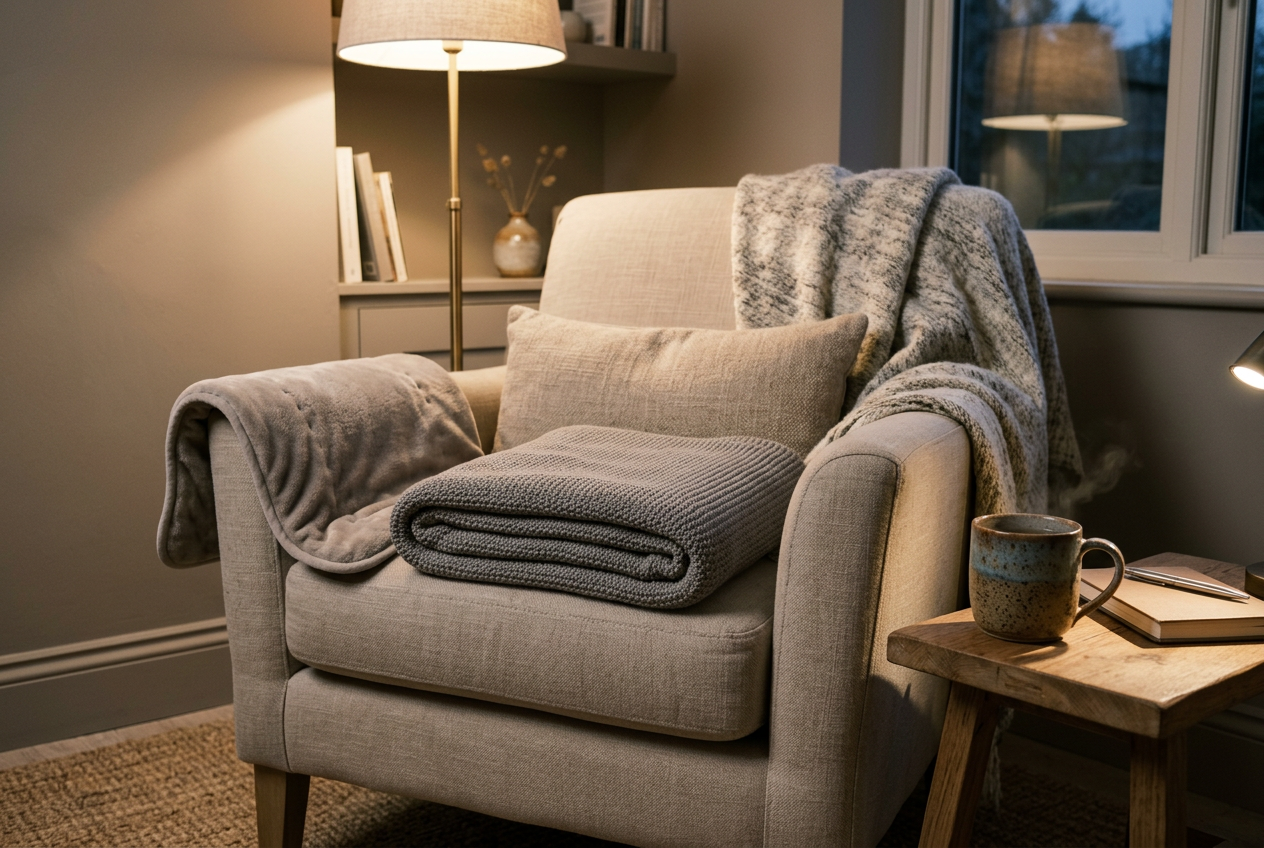
The relaxation category is where marketing works worst and physics works best. Worst, because it is full of vague promises about energy, toxins and rebalancing that do not survive serious scrutiny. Best, because beneath the noise sit three very concrete and very old mechanisms — applied heat, distributed weight, passive support — that cure nothing but make staying still more bearable, make it easier to stop clenching your shoulders, and shorten the time between the sofa and sleep. This guide is about those three mechanisms: how the objects that use them are built, which parameters separate a sound product from a useless one, and where the safety limits sit. One premise applies to everything that follows: none of these products is a medical device, none treats any condition, and none replaces a consultation. If you have persistent, recurring or unexplained pain, the first step is to speak to a healthcare professional.
1. What applied heat actually does
Local heat is the oldest comfort tool we have, and also the most misunderstood. In simple terms, what it does is raise the surface temperature of tissue in a limited area. The perceived result is a sensation of muscular relaxation and less stiffness in movement over the following minutes. It is a real but temporary effect, and it is worth being clear: it lasts about as long as the application and a little beyond, it does not change whatever made us stiff, and it is not a therapy.
That said, within those limits heat is extremely useful. After a day at a desk, a heating pad on the neck makes it far easier to release shoulders held tense for eight hours without noticing. On a cold evening, a foot warmer noticeably shortens the time needed to fall asleep, because difficulty sleeping with cold feet is a well-known phenomenon and a fairly trivial one to solve. The value of these objects lies exactly there: in making an ordinary situation more comfortable, not in promising more.
There is, however, an important difference between dry and moist heat, and between continuous and intermittent heat. The dry heat of an electric pad is convenient, clean and adjustable; the moist heat of a compress penetrates with a different sensation but takes more managing. On continuous versus intermittent the practical rule is clear: short, repeated applications — twenty minutes, then a break — are preferable to an uninterrupted hour, both for perceived effectiveness and for skin safety.
2. Heating pads and thermal cushions: how to choose
The electric heat family is the widest in the category and the easiest to assess, because the parameters are objective.
Surface and shape
The first criterion is the match between the shape of the product and the area you want to warm. A wide rectangular pad, like the UFESA N2 thermal cushion, 46 x 34 cm, covers the lower back or abdomen well, where a continuous surface is what is needed. A shaped model for neck and shoulders, like the Galiplus electric cushion for neck and back, solves a problem the rectangle does not: staying in place without sliding as you move. It looks like a cosmetic detail; it is in fact the main reason many generic pads end up in a drawer.
Power and temperature levels
The stated wattage — for example the 100 W of the Orbegozo 18043 heating pad — indicates how quickly the product reaches temperature, not how hot it gets at maximum. A higher figure means less waiting. The parameter that matters more, in practice, is the number of settings: three levels is the sensible minimum, because the right heat for the lower back under a jumper is not the right heat for a bare neck. Multifunction models such as the Galiplus multifunction electric heating pad are built precisely around versatility across different areas.
Safety: three non-negotiable checks
On a product that heats and sits against the skin, three features are not optional. Automatic shut-off after a set time, which protects against falling asleep and forgetting. A removable, washable cover, because fabric spending hours against skin needs washing and the heating element cannot go in a machine. And electrical certification, with compliant marking and a cable in good condition. To these add two usage rules: never use a heating pad on broken skin or on areas with reduced sensitivity, and never fold or compress it while it is switched on, because the fold concentrates heat and damages the internal elements.
3. Weighted blankets: weight as a signal
The weighted blanket is the most debated object in the category. The idea is simple: a blanket filled with glass microbeads or granular material spreads a uniform, constant pressure across the body — what is called deep pressure. Many people describe it as a sense of containment that helps them relax and stay still. Scientific evidence for this effect exists but remains limited and inconsistent: we are talking about perceived comfort, not a treatment with demonstrated efficacy.
The parameter that decides everything is weight. The most widely cited rule suggests around 10% of body weight, with a margin either way according to personal preference. A single weighted blanket of 120 x 180 cm is designed for individual use, and this is the second criterion not to get wrong: a weighted blanket should be chosen to the size of the person, not the size of the bed. A blanket that overhangs the mattress slides towards the floor during the night, dragging its weight with it, and you end up waking to retrieve it.
The third criterion is breathability. Weight brings heat with it, and a weighted blanket in a poorly breathable fabric becomes unusable from May to September. Anyone wanting year-round use should look for cotton or open-weave covers, and consider two different covers for the two seasons.
On safety, clarity is needed. Weighted blankets should not be used with young children, nor by anyone unable to remove them independently, nor in the presence of respiratory or circulatory conditions without medical advice. It is a comfort object for autonomous adults, and should be treated as such.
4. Passive support: lumbar cushions and supports
The third mechanism neither heats nor weighs: it supports. A lumbar support does nothing active; it simply fills the empty space between the lower curve of the back and the chair. That gap is why, after an hour seated, the pelvis rotates backwards and the back rounds: not because we sit badly out of laziness, but because without support the neutral position cannot be held without continuous muscular effort.
A portable breathable lumbar support solves the problem in the simplest possible way: it gives the curve something to rest against, and the body stops having to hold it. There are three selection criteria. Thickness, which should match the real depth of your own lumbar curve: too thin and it does not make contact, too thick and it pushes you forward, creating an opposite tension. Fixing — the strap or elastic that keeps the support on the backrest; without it, it slides down within ten minutes. And breathability, because a support in contact with the back for hours in a car or at a desk becomes an annoying heat source if it is not ventilated.
A note about expectations: a lumbar support makes sitting more sustainable, but it does not replace standing up. The variable that weighs most on the comfort of desk work is not the cushion, it is how often you interrupt. The support improves the hour between one break and the next; it does not remove the need for the break.
5. Foot warmers and heated underblankets: the cold that keeps you awake
There is a band of products solving a very specific and very common cold-weather problem: difficulty relaxing and falling asleep with cold extremities. It is a known phenomenon, tied to body temperature regulation in the phase preceding sleep, and it has a trivially mechanical solution.
The Elewa 2-in-1 electric foot warmer works on the most effective point, the feet, and has the advantage of being localised: it warms where needed without heating the whole bed. Versions with several adjustable temperature levels, like the ergonomic portable three-level model, let you start warm and step down gradually.
The double heated underblanket, 140 x 160 cm instead works across the whole surface, with a different benefit: pre-warming the bed before you get in, so that first contact with the sheets is not the least pleasant moment of the evening. Correct use for underblankets is exactly that — switch on twenty or thirty minutes beforehand and switch off before sleeping, rather than leaving it on all night. On double models with two zones, the split wattage (for example 60+60 W) indicates that the two sides adjust separately, which resolves the difference in thermal perception between two people in the same bed.
The safety rules here are the same as for heating pads, with one specific addition: an underblanket should not be used folded, should go under the sheet rather than over the body, and should be checked periodically to ensure the internal wires have no permanent creases.
6. Five common mistakes
Expecting a cure. This is the mistake that generates every disappointment in the category. Heat, weight and support improve the comfort of a situation; they do not resolve the cause of pain. Asking them for what they can give makes them extremely useful objects; asking for more makes them wasted money.
Buying a weighted blanket sized to the bed. This is the most frequent and most expensive error, because it makes an object that is not cheap unusable. A weighted blanket is measured against the person, not the mattress.
Using heat for too long. An uninterrupted hour is no more effective than twenty minutes, and exposes the skin to an entirely avoidable irritation risk. Short cycles with breaks work better.
Choosing the thickest lumbar support available. Excessive thickness does not give more support: it pushes the trunk forward and creates a new tension, usually between the shoulder blades. The right thickness fills the gap; it does not exceed it.
Ignoring washability. All these products spend hours against the skin. If the cover does not come off and wash, after a few months the issue is no longer comfort but hygiene.
7. Maintenance and longevity
Maintaining electric heat products is simple but has precise rules. The heating element is never immersed in water and never goes in a machine: clean it with a slightly damp cloth while switched off and unplugged, and let it dry completely before switching on again. The cover comes off and washes according to its label, usually at low temperature. Out of season, these products should be stored rolled or flat, never folded with sharp creases, because the crease is where internal wires break.
Weighted blankets require attention to weight when wet: a seven-kilo blanket absorbs water and can exceed the capacity of many domestic machines, damaging them. The practical solution is a washable duvet-style cover, washing the inner blanket rarely and according to the manufacturer's instructions. Drying should be done flat, never hanging, because weight concentrated on the upper seams strains them and makes the filling migrate.
Foam supports progressively lose elasticity: when the cushion no longer returns to shape after being compressed, it has finished its cycle, and continuing to use it means having no support while believing you do. It is a gradual deterioration and therefore hard to notice; one check a year is enough.
8. Seasonality: when they genuinely help
This category has a marked seasonality, and knowing it helps both with the choice and with the timing of purchase. Heating pads, foot warmers and underblankets live from October to March, and demand explodes in the first genuinely cold week — which is also the worst moment to buy them, because the range thins out. The sensible window is late summer, when the choice is complete.
Weighted blankets have a blurrier seasonality: those who use them for the comfort of weight keep them year-round, changing the cover; those who also use them for warmth put them away in spring. If the goal is weight and not heat, it is worth going straight for light, breathable covers, which extend use to nine months instead of five.
Lumbar supports, finally, have no season. They are tied to hours spent sitting, and those do not change with the weather — if anything they increase in winter. It is the item in the category that makes most sense to buy at any time, and also the one that, for the same outlay, touches the largest number of hours in the day.
The selection
A considered selection from the Dedalshop Relaxation Products category, organised around the three mechanisms discussed above: heat, weight, support.
- UFESA N2 thermal cushion, 46 x 34 cm — a wide, continuous surface for lower back and abdomen.
- Galiplus electric cushion for neck and back — a shaped form that stays in place without sliding.
- Galiplus multifunction electric heating pad — versatile across different areas of the body.
- Orbegozo 18043 heating pad, 100 W — wattage that shortens the time to reach temperature.
- Sweikett single weighted blanket, 120 x 180 cm — individual size, the correct one to stop it sliding off the bed.
- Backonfy portable breathable lumbar support — something for the lumbar curve to rest against, at a desk and in the car.
- Elewa 2-in-1 electric foot warmer — heat localised to the most effective point.
- Ergonomic portable foot warmer, three levels — progressive temperature adjustment.
- Blewarm double heated underblanket, 140 x 160 cm — dual 60+60 W zones for two different thermal perceptions.
Mini-FAQ
How heavy should a weighted blanket be?
The most widely cited guidance is around 10% of body weight, adjusted to personal preference. Size matters just as much: choose it against the person, not the bed, or it will slide towards the floor during the night.
How long can a heating pad stay on?
Short, repeated applications of around twenty minutes with breaks work better than a continuous hour and reduce the risk of skin irritation. A built-in automatic shut-off is the most useful safeguard, especially in the evening.
Do these products cure back pain?
No. Heat, weight and support improve the comfort of a situation — sitting, staying still, falling asleep — but they are not medical devices and do not treat any condition. For persistent, recurring or unexplained pain, the reference point is a healthcare professional.
Can a heated underblanket stay on all night?
The correct use is pre-warming: switch it on twenty or thirty minutes before going to bed and switch it off before sleeping. Always follow the manufacturer's instructions, and never use the product folded or over the body.