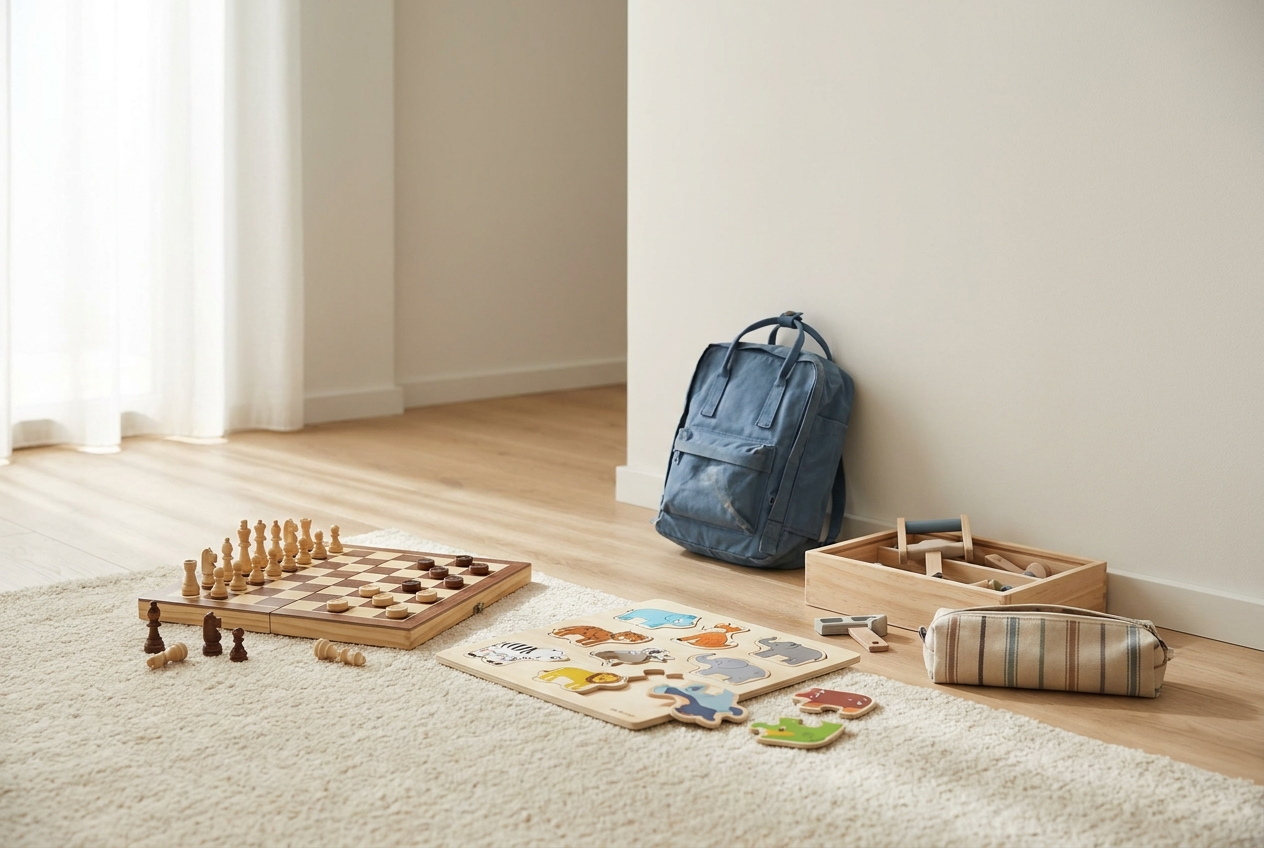
A gift for a child is judged badly at the moment of unwrapping and well three weeks later. In the first minute the loudest, brightest, biggest object almost always wins. Then comes the ordinary week — no party, no guests, no group excitement — and that is when you see which objects find their way back into a child's hands and which end up at the bottom of a basket. This guide is not about which toys are "educational", a word that no longer says anything. It is about something more measurable: what makes a gift reusable. Namely the real age it is calibrated for, the kind of play it triggers, the materials that stand up to use, the number of pieces that can go missing before it becomes unusable, and the space it demands from the home that receives it — which is often not our own.
1. The criterion that matters: how often it comes back into their hands
A toy used twenty times in a year is worth more than one used three times with great enthusiasm. It sounds obvious, but almost nobody chooses that way. The reason is that at the point of purchase we picture the moment of the gift, not the scene on a Tuesday afternoon.
Closed play and open play
A closed game has one way of being used and one conclusion: you do it, you finish it, you put it away. An open game can be picked up differently each time, and each time produces something slightly different. It is not that the first is wrong — a jigsaw is closed play and it is excellent — but the two have very different life cycles, and applying the same expectation to both leads to disappointment.
The activation threshold
This is the time and help needed before play actually starts. An object that requires fifteen minutes of adult assembly, or instructions read together, will be used far less than one that starts in ten seconds. Not because it is worse, but because most play moments are short and unplanned. If the gift is meant to be the Sunday game with parents, fine. If it is meant to be the solo afternoon game, the threshold must be extremely low.
Counting the pieces
Every separate piece is a piece that can vanish. A game with four large elements survives a house move; one with forty small pieces and no container included has an average life of a few months. That is not a reason to avoid games with many pieces: it is a reason to check they come with a decent box or bag, or to add one.
2. Age: the one on the box and the real one
The age marking on the packaging is first of all safety information — especially the classic three-year limit, which signals a choking risk from small parts and must be respected without exception. But as a guide to how play develops it is crude. It is worth thinking in use bands.
Three to five
Symbolic play dominates: imitating the adult world. Shopping trolleys, tool sets, kitchens, doctor's cases. Here quality is not in the realism of details but in sturdiness: these objects get dragged, tipped over, loaded up and used daily for months. Wheels and joints are the weak point to check first.
Six to eight
Rules arrive. The child begins to tolerate — then to seek out — games with constraints, turns and a winner. It is the right age for the first real board games and for hands-on puzzles. It is also the age when structured physical play appears: scooter, jumping, balance. And school arrives as identity: the backpack and pencil case stop being accessories and become personal objects with real symbolic weight.
Nine to twelve
Here the challenge must be genuine or the object is judged "for little kids" and abandoned instantly. Chess, draughts, jigsaws of hundreds or thousands of pieces, puzzles that demand method. This is the age when an over-simplified gift is an insult, and when an object designed for adults but accessible is appreciated far more than one designed for children.
3. Materials: what holds and what gives
There is no absolutely right material. There is a material suited to the kind of stress involved.
Wood
It lasts decades, does not fade, does not smell, and has a weight that communicates solidity — something children register more than you would think. It is the ideal material for boards, pieces, interlocking parts: objects that stay still and get handled. Check for: rounded edges, even varnish without splinters, and — in board games — a container for the pieces, because the board lasts forever but the pieces go missing.
Rigid plastic
It is the correct material for anything thrown, dragged or left outside. A trolley or tool set in sturdy plastic survives treatment that would destroy wood. The critical point is not the material itself but the thickness at stress points: handles, axles, hinges. If a handle flexes visibly under hand pressure, it will break.
Card and cardboard
The material of jigsaws and boxes. Quality shows in two things: the thickness of the board and the precision of the die-cut. A jigsaw whose pieces fray at the edges after two assemblies is a single-use jigsaw. And for large jigsaws one mundane detail matters too: where they will be left half-done. A thousand-piece puzzle without a dedicated surface is a source of domestic conflict.
Fabric: backpacks and cases
Here you look at the points that fail first, always the same ones: strap attachment, zip slider, base. Reinforced stitching at the shoulder straps and metal or thick nylon sliders make the difference between two years and five. And for a school backpack: a padded back and wide straps are not an aesthetic luxury, they are what distributes a load children carry every day.
4. The gift families, and what they are for
Rather than thinking in product categories, it helps to think in terms of the kind of moment the gift creates.
Symbolic play
Recreating the adult world to scale. It helps process and narrate, and it fades naturally around age six. The typical gift imitates a real tool — a trolley, a toolbox — and its lifespan depends almost entirely on sturdiness.
Rule-based play
Two or more people, a shared constraint, an outcome. This kind of play carries an important consequence: it requires someone to play with. Giving a board game to an only child without considering who will play it is a frequent mistake. In exchange, when it works, it is the longest-lived gift family of all: a chess board bought at eight is still in use at forty.
Individual puzzles
Cubes, interlocking pieces, jigsaws. The great advantage is that they require nobody: you pick them up and do them. It is the right gift for waiting moments, for travel and for children who get bored quickly but do not want a screen. The risk is calibration: too easy and it is abandoned in a day, too hard and it is abandoned in an hour.
Movement
Scooters, jumping, balance. It is the family with the best ratio of cost to hours of use, but it is also the only one requiring an external condition: somewhere to use it. Before giving something that moves, ask where it will be used — courtyard, park, pavement — and whether that family has that space.
School and identity
Backpacks, cases, sports bags. They are not "boring" gifts as people believe: for a child of six and up they are strongly personal objects, and receiving one's own, well chosen, has a different value from an anonymous accessory. It is also the category where quality is most easily felt in daily use.
Atmosphere
Lights, projectors, objects that change a room. It is not play in the strict sense, but it solves a specific, recurring moment: the evening, the transition to sleep, the bedroom becoming less hostile with the lights off. These are small gifts with a disproportionate daily impact.
5. The recurring mistakes
Buying for an older age "so it lasts". It almost never works. A game that is too hard is tried once, failed and shelved; by the time the child is the right age, the object has already been mentally discarded.
Ignoring the recipient's space. A large object given to a family in a small flat becomes a logistical problem, and logistical problems end up in the cellar.
Not asking whether they already have it. This applies above all to classic board games and jigsaws: overlap is extremely common and awkward for everyone.
Underestimating batteries. A toy needing four batteries that are not included, or an uncommon format, has a good chance of staying switched off. If the gift runs on batteries, give the batteries too.
Buying the huge set when the medium one is enough. In games with many components, the giant set is often used at fifty per cent and complicates tidying up. Fewer pieces, all used, is better.
Forgetting the container. A game with nowhere to return to does not return. A sturdy bag or box extends a gift's life more than any feature of the gift itself.
Buying for the child we imagine. It is the most affectionate mistake and the most common: we give what we would like them to enjoy. Observing what they already do, and giving the next piece of that thing, works better almost every time.
6. Safety: the few things that are not negotiable
Few rules, all of them binding. Under three, no small parts: the limit on the packaging is not a commercial suggestion but an indication of choking risk. Long cords and strings should be avoided in toys for the youngest. Button batteries deserve particular attention: the compartment must be screwed shut, always, and spare batteries kept out of reach as you would keep a medicine.
For movement toys — scooters, jumping objects, anything involving balance — a helmet is not optional, and the first use should always be supervised by an adult on a flat, smooth surface, not downhill and not on gravel. It is also worth periodically checking the tightness of screws on moving objects: they loosen with use, silently, and that is where falls come from.
Finally, the common sense that always applies: check conformity markings, keep plastic packaging away from the youngest and do not let the wrapping become part of the game.
7. Useful comparisons
Jigsaw or board game?
The jigsaw is individual, quiet, needs a surface and produces a result that is then dismantled. The board game is social, noisy, needs people and produces a repeatable ritual. If the child has siblings or often sees cousins, the board game has many more occasions for use. If they are often alone or travelling, the jigsaw wins.
Chess or a hands-on puzzle?
Chess requires an opponent and a long learning curve, but it is the longest-lasting object of all and carries into adulthood. A cube or hands-on puzzle requires nobody and gives satisfaction in minutes, but has a shorter life: once solved, it often ends there. Many families give them together for exactly this reason.
Scooter or jumping toy?
The scooter needs smooth, continuous outdoor space — a courtyard, a park, a long pavement — and becomes transport, so it gets used a great deal. A jumping toy needs far less space but more supervision and has a shorter, more concentrated use. In blocks without a courtyard, the second is often the only realistic option.
School backpack or casual backpack?
They are not interchangeable. The school backpack has a structured back, A4 capacity and compartments designed for a heavy daily load. The casual backpack is lighter, smaller, designed for a jacket and a snack. Giving the second while meaning to solve the first leads to two purchases instead of one.
8. Seasonality: when to give what
Spring and summer birthdays
The natural moment for movement gifts and anything used outdoors: long days and holidays give the immediate occasion for use that makes a gift memorable. A scooter given in November spends four months in the cellar before its first ride.
Late summer and back to school
August and September are the window for the backpack, the pencil case and the sports bag. Bought before the return they are also a better choice than bought during: you choose calmly, you check the fit on the child's shoulders, and you do not end up taking whatever is left.
Autumn and winter
The season of board games, jigsaws and puzzles: short afternoons, more time indoors, more occasions for shared play. It is also when a large jigsaw finally finds the time to be completed.
All year round
Atmosphere gifts — lights, projectors — and symbolic play have no season: they answer daily needs that do not change with the calendar.
9. Making it last: care and repair
A few habits greatly extend the life of these objects. Backpacks are emptied completely before washing, washed by hand or on a delicate low-temperature cycle and dried open in the shade, never on a radiator: direct heat deforms padding and back panels. Zips are cleaned by wiping the teeth occasionally, because it is sand and not use that ruins them.
Wooden games want only a slightly damp cloth and no soaking: water entering the joints makes them swell and creates play. Jigsaws go back in the original box, and when the box gives out — it always does — a resealable bag per puzzle saves the whole thing.
For toys with moving parts, a check every few months is worthwhile: screws tight, wheels free, no cracks near the axles. And one simple rule that solves half the problems: one basket or box per play family, not a single container for everything. A single container guarantees that no game is ever complete.
The selection
Real products from the Dedalshop catalogue, chosen to cover the different play families and ages.
- Scuvol InnovaGoods 3-in-1 Convertible Scooter — a movement gift that follows growth instead of being outgrown in a season.
- Funp InnovaGoods Rubber Pogo Stick — physical play for tight spaces, where a scooter would have nowhere to run.
- Cayro 751 Wooden Chess and Draughts Board — two games in one object, the longest-lived gift on this list.
- Cayro YJ8313 Unequal Cube 3 x 3 — an individual puzzle with zero activation threshold: pick it up and go.
- Educa The Marvellous of Disney II Jigsaw, 1000 pieces — an older-child format, to be planned with a dedicated surface.
- VIC00099 Supermarket Trolley — classic symbolic play for the three-to-five band, sturdiness before realism.
- Tool Set — imitation of adult work, the play family that survives months of daily use.
- BlackFit8 M773 School Backpack, light blue, 32 x 42 x 15 cm — a true school format, back panel and straps designed for a daily load.
- BlackFit8 M248 School Case — the roomy case that goes with the backpack, a personal object more than an accessory.
- Vezda InnovaGoods LED Star Projector — a small gift with daily impact: it solves the evening.
Quick questions
One big gift or two small ones?
Two small ones, almost always, if they belong to different play families. A puzzle plus something to use outdoors covers two kinds of moment; a single large object covers one and risks missing the target entirely.
How do I choose if I do not know the child well?
Go for low-threshold, high-tolerance families: a classic board game, a puzzle, an everyday object like a backpack. Avoid characters and licences, because they are the part of taste that changes fastest and with least warning.
Do board games really work for only children?
Only if someone at home is willing to play consistently. Chess and draughts live on repeated games: without a regular opponent, an individual puzzle gives far more satisfaction.
How much does the brand matter?
Little in itself, a lot for what it usually implies: availability of spare parts, consistency of materials between batches and declared conformity. Those three things are worth checking, not the name.
And if the gift is not liked?
It happens, and it is not a failure. It is worth offering it again after a few months: many games are rejected simply because they arrived too early, and rediscovered six months later they become the favourite. Keeping the receipt helps anyway.