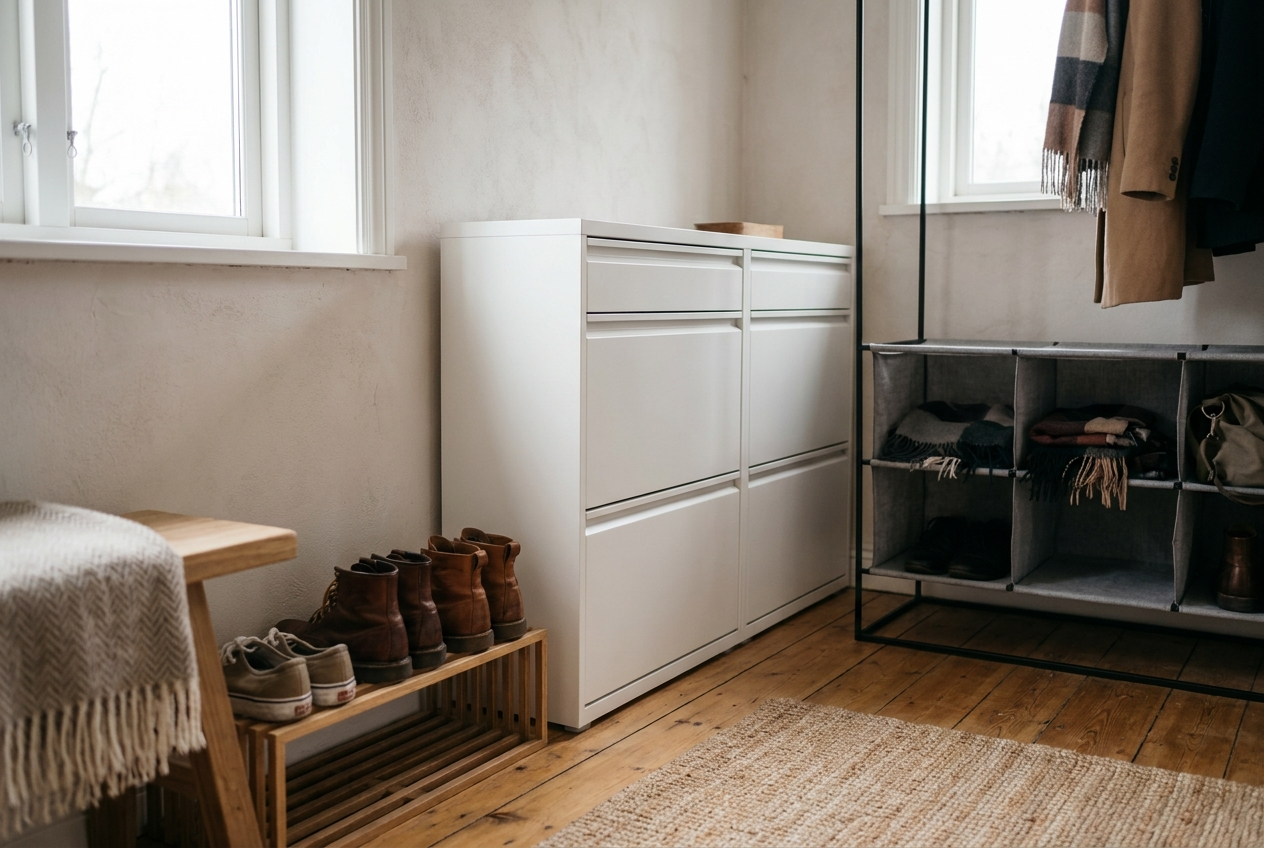
The entrance is the part of a home that breaks first, and it always breaks the same way: not for lack of space, but for lack of a destination. Shoes taken off on the way in have no obvious home, so they stay where they land; after three days the row by the door is an obstacle, after three weeks it is a habit. Shoe storage only solves the problem if it respects a few very concrete physical parameters — real depth, height between shelves, stated capacity versus actual capacity, ventilation — and if it matches the way you genuinely come into the house. This guide lines up those parameters, distinguishes the four families of available solutions and tackles the problem no catalogue names: odour. The timing, as it happens, is right. Between late August and October comes the most demanding seasonal rotation of the year, the one in which sandals and light shoes have to leave the stage and boots and closed footwear have to find room.
1. Why the entrance is where a home breaks
There are two reasons, and neither is about square metres. The first is that an entrance is a transit zone, meaning a place you pass through with your hands full, in a hurry and with no intention of organising anything. Any system requiring more than two gestures — opening a door, lifting a lid, bending down, aligning — will be bypassed within the first week. The second is that the quantity of shoes in circulation is not constant: it changes with the season, the number of people and the weather of the preceding days. A system sized on the average number of pairs works until the first rainy day, when four wet pairs come in that cannot be shut inside a cabinet.
From this comes the most useful criterion for designing an entrance, namely distinguishing two different functions that are often conflated. There is storage, meaning where the shoes you are not currently using live: it can be closed, it can be deep, it can take a few extra gestures. And there is parking, meaning where shoes just taken off end up — reachable with one foot, kept ventilated and ideally able to dry. Almost every entrance that does not work has only one of these two functions. Almost every one that works has both, even in two square metres.
2. The four families of shoe storage
The tilting slim cabinet
This is the format that made shoe storage viable in narrow corridors. Drawers open by rotating forward and shoes sit almost vertically on an inclined plane, which cuts cabinet depth to twenty-five or thirty centimetres against the forty of a traditional wardrobe. It is the right solution where circulation space is tight and you want a top surface for keys and post. It has two limits worth knowing before buying: real capacity per tilting unit is almost always lower than stated, because the catalogue figure refers to low women's shoes, and tall footwear — ankle boots, bulky trainers, walking shoes — simply does not fit the intended incline.
The closed shoe cabinet
A vertical structure with doors and shelves, often with adjustable heights. It is the most capacious choice per square metre occupied and the tidiest visually, because it hides everything. It works very well as storage for the off-season and for shoes belonging to people who do not wear them daily. It works very badly as parking: opening a door to put away shoes you have just removed is exactly the extra gesture nobody makes. It is also the format where humidity is most serious, because a still-warm shoe closed into an unventilated volume is precisely the premise of the unpleasant surprise two weeks later.
The portable modular in fabric and metal
A structure of push-fit metal tubes, shelves in technical fabric or mesh, removable cover. It is the most flexible solution: it assembles without tools, adapts to the available niche, moves into a storeroom when the season changes and folds down when needed. Ventilation is excellent precisely because it is not a sealed cabinet. It is the most rational choice for renters, for irregularly shaped entrances and for the seasonal surplus that has to live somewhere but not in the hallway. The limit is structural: fabric shelves flex under heavy loads, so they should be reserved for light and medium footwear rather than a row of boots.
Shoe holders and organisers
The most underrated family. These are the small systems that add no furniture but make better use of what is already there: adjustable holders that stack the two shoes of a pair, cutting linear footprint by around forty per cent, and adhesive or wall fixings that lift shoes off the floor and free the surface to be cleaned. Inside an existing wardrobe, six adjustable holders can hand back the space of an entire shelf. Under a cabinet or behind a door, a wall fixing creates zero-cost parking that takes no circulation space. They do not solve an overall volume problem, but they almost always solve the density problem — which is the real one.
3. The calculation almost nobody does
Depth: the measurement that decides everything
A men's size forty-three shoe is around thirty centimetres long; a women's thirty-eight sits at about twenty-six. A cabinet with twenty-five centimetres of internal depth therefore holds neither flat: it takes them only tilted or edgewise. This is exactly why slim cabinets work with a tilting mechanism rather than horizontal shelves. The check to run before buying is trivial and almost nobody runs it: measure the longest shoe you own and compare it with the stated usable depth, not with the external footprint of the cabinet.
Height between shelves
Low shoes need twelve to fourteen centimetres; bulky trainers and high loafers fifteen to eighteen; ankle boots twenty to twenty-five; tall boots do not lie flat at all and should be kept upright, in a dedicated compartment or hung. A cabinet with fixed fifteen-centimetre shelves looks generous until winter arrives. The practical rule: favour models with at least one adjustable shelf or one tall compartment, because seasonal variability is certain while millimetre optimisation is pointless.
Stated pairs versus real pairs
Catalogue capacities are almost always calculated on low women's footwear, arranged alternately toe-to-heel and with no margin. In a mixed household the realistic ratio is around seventy per cent of the stated figure: a twelve-pair cabinet holds eight or nine in real use. It is better to oversize by twenty or thirty per cent from the start, because a shoe cabinet that is one hundred per cent full stops being used: when putting something away requires moving something else, shoes go back on the floor.
4. Ventilation and odour: the physics of the problem
Footwear odour is not a matter of personal hygiene but of residual moisture. A foot produces a significant amount of perspiration over a day, and much of it ends up absorbed into the lining and the insole. If the shoe is immediately shut into an unventilated volume, that moisture does not evaporate: it stays warm in a dark environment, which is the ideal condition for the bacterial activity responsible for the smell. The problem, therefore, is not solved by perfuming the cabinet — which masks without removing the cause — but by letting footwear dry before putting it away.
Three practical implications follow. First: provide an open parking zone, however small, where shoes just taken off stay ventilated for a few hours before going into the closed cabinet. Second: prefer cabinets with a perforated back, a grilled base or louvred doors, or at the very least leave the doors ajar in winter. Third: rotation. Wearing the same pair two days running gives it no time to dry, and it is the single most frequent cause of persistent odour. Alternating two pairs solves most cases without buying anything.
In closed cabinets it is worth adding a moisture absorber or a sachet of hygroscopic material, replaced when saturated. And the simplest rule of all applies: wet shoes never go into a closed cabinet — they dry outside it at room temperature and away from direct heat sources, which distort adhesives and leathers.
5. Materials and finishes: what actually lasts
Melamine-faced particle board is the standard of this category: inexpensive, dimensionally stable, available in any finish. Its weak point is single and predictable, namely the edge in contact with moisture. If a wet shoe sits on a melamine shelf with an unsealed edge, the panel absorbs water, swells and never returns. Checking the edging on exposed sides is more useful than debating thicknesses.
Powder-coated metal is the most robust choice for structures and handles humidity well, with the only caution being weld points and contact points, where the coating chips and rust starts. Structural plastic and polypropylene are the most relaxed materials of all where water is concerned, which is why they appear in every modular system and shoe holder: they wash, they do not swell, they hold no odour. The technical fabric of modular units should be chosen with attention to how it fixes to the tubes, which is where budget models fail first.
On refurbished products the assessment is concrete rather than ideological: for an entrance cabinet, where the value is functional and cosmetic marks end up against a wall or under shoes, grade A or B often represents the best ratio between spend and capacity gained. What to check is the completeness of the hardware and the integrity of the edges, not micro-scratches on the top surface.
6. Seven common mistakes
Buying based on space rather than on shoes. The right question is not how many centimetres are free in the corridor, but how long the biggest shoe is and how tall the tallest ankle boot is.
Putting everything behind a door. A storage-only entrance always produces a row of shoes on the floor, because the one-gesture parking is missing.
Putting away still-warm footwear. This is the number one cause of odour. An hour of air before closing the door is worth more than any deodoriser.
Filling to one hundred per cent. A saturated shoe cabinet stops working as a system: you need margin, because the quantity of shoes in circulation fluctuates by definition.
Overloading fabric shelves. Modular units flex under concentrated weight. Heavy footwear belongs low down, on rigid shelves or directly on the floor.
Not securing tall cabinets to the wall. A narrow, tall shoe cabinet with doors open and load shifted forward is unstable. The anti-tip kit is not a detail, especially with children around.
Treating the seasonal rotation like a house move. Postponing it for weeks means keeping twice the necessary shoes in the entrance during exactly the period when more of them arrive wet.
7. The seasonal rotation, and why to do it now
Late August and September are the right window, not for aesthetic reasons but for practical ones: it is the only moment in the year when summer footwear has finished its service and winter footwear has not yet started, so both can be handled without pressure. The sequence that works is simple and takes about an hour.
Take everything out, split it into three groups — daily use, occasional use, out of season — and assess the fourth group nobody wants to look at, namely the shoes that will never be worn again. Then clean and thoroughly dry the summer ones before storing them, because sandals and canvas shoes put away dirty and damp develop stains and odour over the winter. Off-season storage goes in the least accessible spot: high in a wardrobe, in the cellar, in the fabric modular moved into a storeroom. The entrance is left to the two groups in use, with free margin for bad weather.
There is one point worth facing now rather than in November: boots. They are the format that defeats any shoe cabinet designed around standard heights and they should be kept upright, with a boot shaper or even just an empty bottle to stop the shaft folding, because once creased it does not straighten again. Knowing where they will go before you need them avoids discovering, once the season has started, that no compartment holds them.
8. Maintenance: the cabinet and what it holds
The cabinet asks for little. Once a season, empty it, wipe the shelves with a barely damp cloth and leave it open for a few hours to dry. Tilting mechanisms have hinges that collect dust and grit: a brush and a drop of dry lubricant keep the closure silent and stop the drawer losing alignment. On modular units, check the tightness of the push-fit joints, which loosen with moving, and the cover, which keeps dust out but should be slipped off now and then to let air circulate.
The contents ask for slightly more, and it is worth it because the ratio of time spent to service life gained is excellent. Brush mud off before it dries, not after. Never dry wet footwear on a radiator or with hot air: leather uppers stiffen and adhesives give way. Pull the insoles out when a shoe is very damp, so the inside dries in half the time. And store structured footwear with a shaper or crumpled paper when it sits idle for months, because an upper that collapses over the summer does not regain its shape in autumn.
9. Quick comparisons: what suits what
Narrow corridor, daily traffic, few shoes in rotation. Slim tilting cabinet, with a top surface. You gain usable surface and lose no circulation space.
Large entrance, big household, many pairs. Closed cabinet as primary storage plus a low open surface as parking. It is the combination that survives bad weather.
Rented flat, irregular entrance, temporary need. Portable modular in fabric and metal. Tool-free assembly, adapts to the niche, collapsible and movable.
Space already occupied by a wardrobe. Adjustable shoe holders and wall fixings. No extra furniture, density nearly doubled, modest spend.
Home with children. A low open shelf at their height for parking, a tall cabinet for storage, anti-tip fixing mandatory. A child puts shoes away if the place is reachable without asking for help.
Mini-FAQ
How deep should a shoe cabinet be?
To hold footwear flat you need at least thirty-two to thirty-five centimetres of usable depth. Below thirty you need a tilting mechanism or an inclined arrangement, which is precisely why slim models exist. The figure to compare is always the stated internal depth, not the external footprint.
How do you avoid odour in a closed shoe cabinet?
By letting footwear dry before putting it away, alternating pairs so none is worn two days running, preferring cabinets with a perforated back or louvres, and adding a moisture absorber to closed volumes. Fragrances mask; they do not solve.
How many pairs does a twelve-pair cabinet really hold?
In a mixed household, realistically eight or nine. Catalogue capacities are calculated on low women's footwear, arranged alternately and with no margin. Oversizing by twenty or thirty per cent is sensible.
Closed cabinet or open rack?
They serve two different purposes. Closed is ideal for off-season storage and visual order; open is indispensable as daily parking, because it costs a single gesture and lets air through. Entrances that work almost always have both.
The selection
A cross-section from the Shoe Storage category: slim formats, closed cabinets, modular units and density systems. Tested, documented, useful.
- Kipit Shoe Rack 68 x 3.5 x 18.5 cm (12 units) — slim elements to arrange on a wall or inside a wardrobe: the density solution, for when the space exists but is badly used.
- Max Home Shoe Cabinet 63 x 43 x 30 cm — a compact format with real depth around thirty centimetres: suited to a small entrance needing an orderly volume rather than a tall cabinet.
- InnovaGoods Portable Modular Shoe Rack, White — push-fit structure and ventilated shelves: tool-free assembly, adapts to the niche, movable at the end of the season.
- InnovaGoods Portable Modular Shoe Rack, Grey — the same logic in a darker finish, better suited to entrances where the unit stays in view.
- Shoe Cabinet, White (Refurbished B) — high-capacity closed storage: the right choice for the off-season, with the recommendation to leave the doors ajar.
- Shoe Cabinet, Grey (Refurbished C) — the same format with more visible cosmetic marks and a lower price: sensible where the cabinet ends up in a utility space.
- InnovaGoods Shoe Rack in Metal and Plastic (Refurbished B) — metal frame with plastic elements: good ventilation and materials that do not fear moisture.
- Sholzzer Adjustable Shoe Holders, InnovaGoods (6 units) — stacks the two shoes of a pair and recovers around forty per cent of linear footprint: the cheapest way to gain space.
- Shohold Adhesive Shoe Holders, InnovaGoods (4 units) — fixings that lift shoes off the floor: one-gesture parking behind a door or under a cabinet, taking no circulation space.
- InnovaGoods Portable Modular Shoe Rack, White (Refurbished A) — the modular unit in grade A, where marks are minimal and the capacity-to-spend ratio is the best in the category.