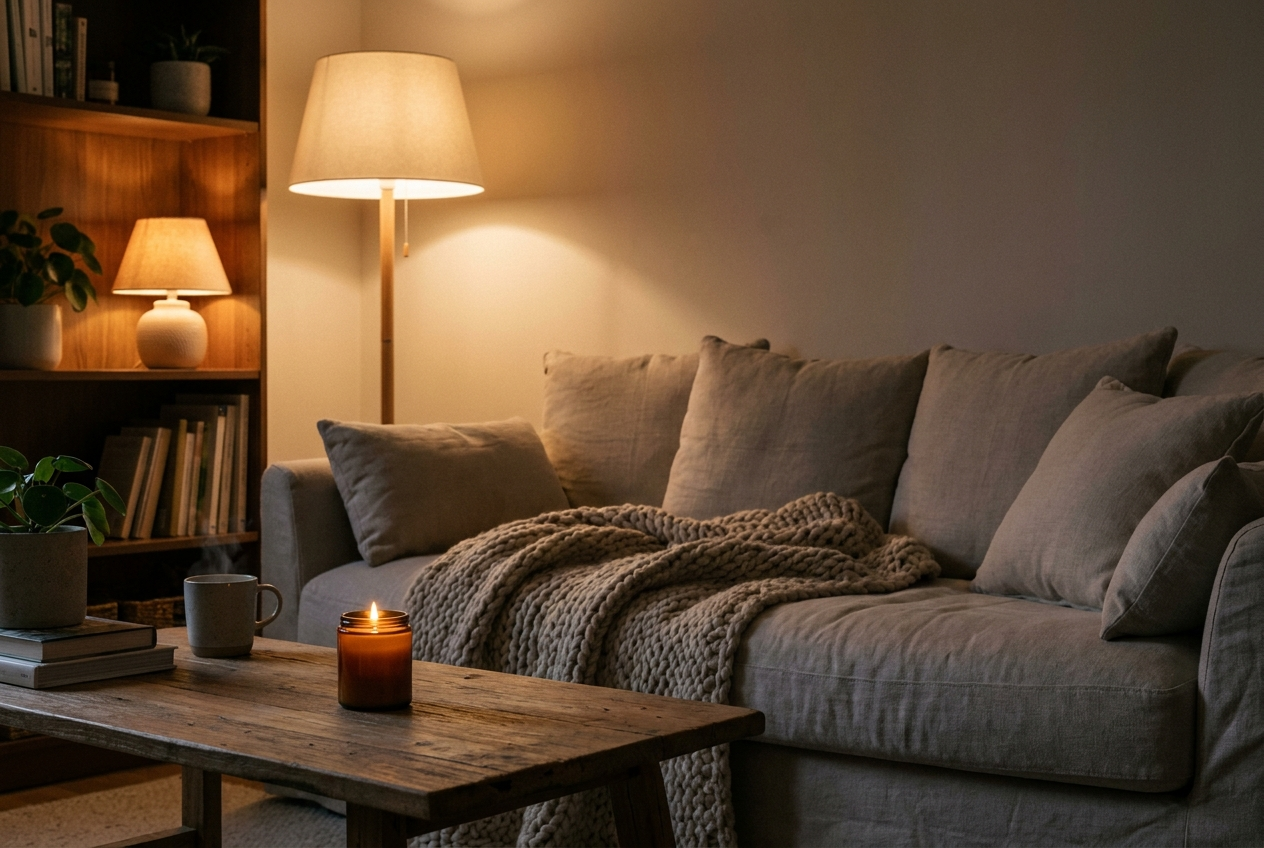
The same room, at nine in the evening, can be a switched-off office or a refuge. The difference isn't the furniture you own: it's a handful of gestures repeated every evening, always in the same order, until the body recognises them before the mind does. You don't need to renovate, you don't need a new sofa. You need a ritual — and a ritual, by definition, is a few well-chosen things repeated with consistency.
This article is not a technical lighting guide. We won't talk about lumens, colour rendering index, or how many watts you need to read without straining your eyes: that's another story, told elsewhere. The thread here is different. Here we talk about atmosphere — how evening transforms a space through five channels: light, scent, texture, sound and rhythm — and how to orchestrate them without turning your home into a scented-candle boutique. Evening is the moment the house stops serving you and starts welcoming you again. The ritual is how you tell it that moment has come.
Why evening asks for a ritual
For most of the day the house is a tool. You work in it, cook in it, pass through it doing other things. Surfaces are lit so you can see what you're doing, the air is neutral, the background hum is appliances and traffic outside. That's fine: by day the house must function. The problem starts when evening comes and nothing changes. The same white light, the same notification-laden silence, the same sofa used as a shelf. The body gets no signal that the day is over, and so it never really ends.
The evening ritual exists precisely for this: to mark a boundary. It isn't an aesthetic question, it's a question of threshold. When you repeat the same gestures every evening, they stop being decisions and become slides. You no longer have to choose to relax — you lower a light, light a scent, and the choice is already made by the gesture. That's why rituals work better than good intentions: they remove the effort of deciding and replace it with a sequence. The house becomes the tool that helps you cross that threshold, every evening, without thinking.
There's also an older, almost animal reason. For millennia the end of the day coincided with a real change in the environment: the sun went down, the light turned red and low, fire became the only source, voices dropped. The body learned to read those signals as the announcement of rest. Fixed, cold electric light erased that passage: today evening can look exactly like noon, and the body stays on alert. Rebuilding an evening ritual isn't nostalgia, it's giving the body back the signals it needs in order to switch off.
Light: from above to below, from white to warm
The first channel, and the most powerful, is light. Not how much you have, but how it's spread and what colour it is. By day light comes from above, diffuse, tending cool: it's light that lets you see well. In the evening you want the opposite. You want light from below or the sides, in pools, warm, with zones of shadow between one pool and the next. Shadow isn't a flaw to erase: it's half the work. A room lit uniformly stays a daytime room even at midnight.
The concrete gesture is simple: switch off the central fixture and turn on two or three low points. A table lamp on the side table, a floor lamp beside the sofa, maybe a candle on a shelf. Temperature matters more than quantity: look for warm tones, around 2700 kelvin, that amber light the sun has at sunset, which our brains have always tied to the day's end. If you have a dimmable source, lower it. If you don't, multiply small points instead of keeping one big one. In the evening the home should be lit the way a face is lit in a portrait: not full-on, but at an angle.
The height of the light
There's a rule worth more than a thousand watts: the lower the source, the closer the evening. Light at ceiling height flattens everything and tells the brain "day". Light at eye level, or below, sculpts objects, lengthens shadows and says "evening". That's why a floor lamp beside the sofa makes more atmosphere than a powerful ceiling spot. When you enter a room in the evening, ask yourself where the highest lit point is: if it's the ceiling fixture, you still have the daytime room. Lower the point of light and the room comes down with it.
The fire that moves
A candle — real or LED — plays its part here too, and not only for scent. The flame, or its imitation, is light that moves. That gentle flicker is a signal of quiet that fixed sources can't give. Keeping one point of living light somewhere in the room, even a small one, shifts the tone of the whole space. It's the difference between a lit room and an inhabited one: the first is still, the second breathes.
Temperature: evening has its own degree
We always talk about light, rarely about real warmth. Yet a cold room won't become cosy however well you light it: a body that's cold stays on guard. Evening naturally lowers the perceived temperature, and the evening ritual should account for it. This doesn't mean cranking up the heating — it means working on warmth of proximity: a throw over the legs, a hot drink in the hands, a corner of the room a little more enclosed where the air doesn't disperse. The warmth of a cup held between the fingers does more, for the sense of refuge, than one extra degree on the thermostat. In the evening you inhabit a warm island inside a cooler house, not an entire home kept at office temperature.
Scent: the sense that opens the door fastest
Smell ties a place to a feeling faster than any other sense, and it's the only one that reaches the brain almost without rational filters. That's why scent, in the evening, is so effective: you don't analyse it, you feel it, and in seconds the room has changed identity. The same neutral air you breathed all day becomes, with one warm note, the air of a different evening.
The rule is to choose warm notes over fresh ones. In the morning and in summer, bright citrus, mint, pine work well: they wake you. In the evening you want the opposite — woods, vanilla, amber, dark citrus like bergamot or bitter orange, soft spices. These are notes that slow you down instead of switching you on. A candle lit for twenty minutes, or a diffuser left going an hour before you sit down, is enough: the goal isn't to saturate the room, it's to give it a base. If walking in you feel the scent like a wall, it's too much. It should be a backdrop you notice only when you look for it.
A practical detail often overlooked: evening scent works better when it isn't the same as the daytime one. If you run a diffuser constantly with the same fragrance, the nose adapts and stops noticing it. Keeping a candle or scent dedicated to the evening keeps the difference alive — and it's the difference, not the intensity, that makes the ritual. Airing out matters just as much: opening the window for five minutes before you start clears the day's stale air and gives the evening scent a clean canvas to settle on.
Texture: what the hands touch
Light and scent work at a distance. Texture works on contact, and closes the circle. A throw over the arm of the sofa, a couple of extra cushions, a rug under bare feet, a heavy curtain that softens the window: all tactile invitations. They tell the body it can settle. It's the difference between a sofa to look at and a sofa to use.
Textiles count double in the evening because they do two things at once. They warm to the touch — wool, velvet, thick cotton give a sense of warmth that bare leather or wood don't. And they soften sound: a room full of hard surfaces echoes, a room with textiles absorbs, and that absorption is already half the quiet. Adding a throw and a rug to a bare living room doesn't just make it warmer to look at: it makes it quieter to live in.
You don't need to overdo it. Texture works by slow accumulation, not total furnishing. A throw you truly love, enough to reach for every evening, is worth more than three throws that stay folded. The test is simple: do you use it, or look at it? If you only look at it, it's decoration. If you reach for it, it's ritual.
The wall is texture too
We tend to think of textiles as things to lay down: throws, cushions, rugs. But vertical surfaces count as well. A canvas on the wall, a hanging, a print on fabric aren't just decoration: they break the acoustic hardness of the bare wall and give the eye a point to rest on as the light comes down. In the evening the gaze looks for a warm anchor, not an expanse of white wall. A soft or figured surface, lit at an angle by a low lamp, becomes the quiet centre of the room.
Sound: turning down the volume of the world
Sound is the most forgotten channel, and often the one that ruins everything else. You can have the right light, the right scent, the right throw, and then a television at daytime volume keeps the room tense. Evening doesn't ask for absolute silence — total silence can unsettle. It asks for a low, continuous, chosen sound. Instrumental music at background volume, a record you know by heart, even the sound of rain or a fan: something that fills the void without demanding attention.
The rule is that evening sound should never force you to raise your voice to talk over it. If, to say something to the person next to you, you have to lift your tone, the volume is a daytime one. Lower it until conversation feels natural again. And switch off the sources you didn't choose: the notification, the standby hum, the background noise you can't even locate. Part of the evening ritual is removing sounds, not adding them.
Sound also works as a boundary, exactly like light. A constant backdrop creates a bubble: inside is the room, outside is the world. When the music stops, the street noise suddenly comes back, and the bubble breaks. That's why many find an evening with a soft backdrop more restful than one in absolute silence: it isn't the sound itself, it's the frontier it draws.
The evening sequence: two minutes, always the same
All of this becomes a ritual only if it becomes a sequence. Five channels to orchestrate sounds like a lot, but in practice it's two minutes of linked gestures, always in the same order. Here's a version you can steal and adapt.
First: light. Switch off the central fixture as you enter the room. Turn on the two or three low, warm lights. This single gesture already changes the tone of everything.
Second: scent. Light the candle or start the diffuser. Let it go ahead of the rest, so the room already smells right when you sit down.
Third: sound. Start the low music, or switch off what you didn't choose. Bring the volume of the world down to evening level.
Fourth: texture. Reach for the throw, arrange the cushions, take off your shoes. This is the gesture that closes the threshold: now the room is yours.
Repeated every evening, this sequence stops being a list and becomes an automatism. That's the point where the ritual really starts working: when you no longer do it, but it gets done to you. The order matters more than it seems: light first because it changes the tone at once, scent right after because it needs time to spread, sound to shut the world out, texture last because it's the gesture with which you finally sit down. Changing the order ruins nothing, but keeping it fixed is what turns four separate actions into a single movement.
Room by room
The ritual changes shape depending on where you are. In the living room, texture and pooled light dominate: it's the room of settling, where throws, cushions and a floor lamp do most of the work. In the kitchen, if you spend the evening there, it's worth having a warm service light beyond the technical worktop one: a low point left on when you've finished cooking turns the kitchen from a laboratory into a room to stay in.
In the bedroom the ritual is barer and more important: here the light should be the warmest and lowest in the house, because it's the last you see. A single bedside lamp, no screens, maybe an LED candle you can leave on without a thought. In the hallway, finally, little is needed: one warm point of light that greets you as you walk in says, even before the living room, that you're home. The bathroom deserves a note of its own: the evening shower or hot bath is a passage rite in itself, and a low light in place of the mirror neon turns ten minutes of routine into a real pause.
Common mistakes
The first mistake is over-lighting. The temptation to switch everything on so you don't trip in the dark erases all atmosphere. Better several small points and an eye that adjusts to shadow.
The second is scent too strong. A fragrance that hits you at the door tires you within ten minutes and becomes part of the problem, not the solution. Less is more: a base, not a wall.
The third is the textile you never use. Buying a beautiful throw and leaving it folded on the backrest is furnishing, not living. Texture only works if you touch it.
The fourth, the subtlest, is having no sequence. Having all the right elements but switching them on at random, one evening yes and one no, builds no ritual. It's repetition in the same order that makes the difference, not the quality of the individual objects.
The fifth, the most modern, is the screen left on. Blue light in your face cancels in an instant all the work done on the room's warm light: the phone and the TV are cold, mobile sources, exactly the opposite of what evening asks for. You don't need to banish them, just lower their brightness or keep them away from the centre of the scene.
Quick questions
How much time does it really take? Two minutes of gestures. The rest is letting light and scent work while you do something else.
Do I have to buy everything at once? No. Start with light — it's the channel that changes the most for the smallest spend. Scent and texture come over time.
Does it work in a studio flat? Yes, and it matters even more: where a single room is both office and refuge, the evening ritual is the only way to separate the two functions without walls.
What if I live with others? A shared ritual works even better. It becomes the common signal that the evening has begun, and one person triggering it is enough for everyone.
And in summer, when it gets dark late? The ritual doesn't depend on the sun but on the hour you choose. If there's still light at nine, lower the blinds and turn on the warm points anyway: you're telling the body your evening has begun, regardless of the sky.
The selection
A few objects, chosen for the five channels of the evening ritual. All in the Home world, Decoration and Lighting subcategory.
- Lady at Night Acorde Candle Set, Turquoise — for scent and living light: several candles lit together give a warm base without overdoing it.
- Lumineo White LED Candle — the flicker of a flame without a flame: leave it on in the bedroom or hallway without a worry.
- Silver Electronics GORT Pendant Light — for the service light of the kitchen or hallway, kept separate from the living room's mood light.
- Flowers Canvas Print (90 x 120 cm) — a textile surface on the wall: it softens sound and gives the room a point to rest your gaze on.
- DKD Home Decor Canvas (53 x 73 cm) — a smaller format for the bedroom or a reading corner: texture and visual quiet together.
- DKD Home Decor Wall Clock — rhythm made visible: a face marking the evening hour helps mark the threshold.
- Versa Congo Photo Frame — the personal detail that makes a refuge yours and no one else's: a photo lit at an angle by the low light.