Twenty minutes are few enough to almost always find, and enough to change the tone of the morning. You don’t need to be flexible or experienced, you don’t need a membership and you don’t even need a dedicated room: you need a small space, a little consistency, and a few objects that make repeating the gesture comfortable. This isn’t a lesson and it promises no results: it’s an invitation to start, with the calm of someone who has nothing to prove.
Why in the morning
The body, just awake, is naturally stiff. We’ve spent seven or eight hours almost motionless, and the first gestures of the day — getting up, dressing, sitting in front of a screen — don’t loosen much. A few minutes of slow movement and breathing, before the day truly begins, is a gentle way to reconnect with the shoulders, neck and back before the desk stiffens them again.
In the morning, too, there’s a quality of silence that the evening rarely returns. The house is still quiet, the phone hasn’t started ringing, and twenty minutes taken from sleep or a hurried coffee are easier to defend than twenty stolen from the evening, when tiredness has already decided for us. The goal isn’t performance and it isn’t even “doing yoga” in the athletic sense: it’s reaching the first commitment a little less tense, a little more present.
It’s worth saying plainly: what follows is gentle movement, within reach of someone starting from zero. It is not medical or therapeutic advice. If you have persistent pain, joint problems, are pregnant or recovering from an injury, talk to a professional first. The body is yours, and no article knows it better than you.
The space: where and how much
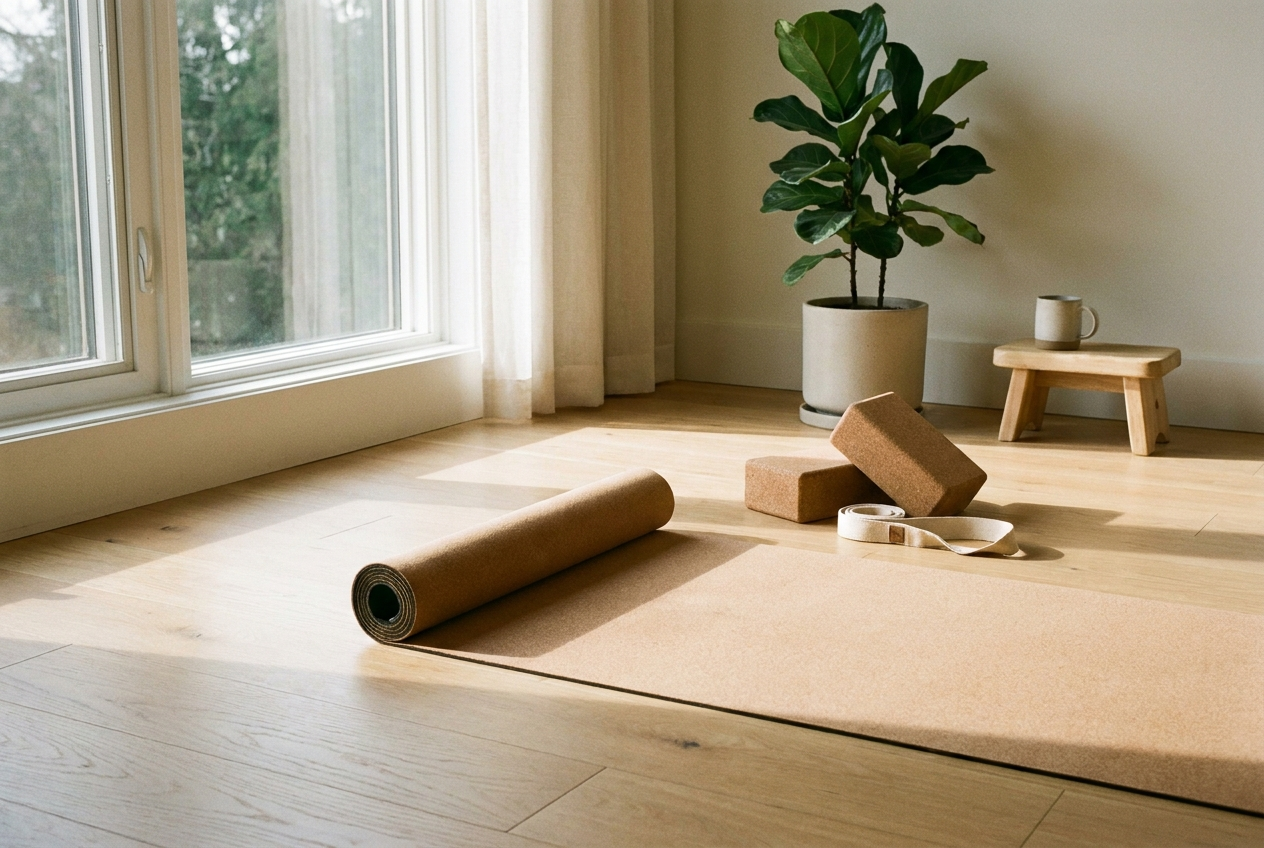
The good news is that little is needed. The space of a mat — roughly your height by the width of your shoulders, plus a little margin for the arms — is enough for almost everything. You don’t need to clear a room: you need to find a corner that stays free long enough that you don’t have to reclaim it every morning.
Choose it, if you can, near a window. The natural morning light is a gentle call, and looking outside while you breathe makes the gesture less closed, less of an “exercise”. Avoid the soft household carpet, which seems comfortable but gives under the hands and makes your supports unstable; better a firm floor with a mat on top. Keep the corner clear of cables, edges and things that fall: safety, here, is mostly common sense.
A detail that matters more than it seems: leave the mat visible. A mat rolled up in a cupboard is a mat that gets forgotten. A mat leaning in a corner, or simply unrolled the night before, is a small silent invitation you meet the moment you get up. Consistency often turns on these logistics rather than on willpower.
The sequence, described with care
What follows is an outline, not a prescription. Think of it as a rough direction — from easier to harder, from the top of the body downward — inside which you move at your own pace. If a step doesn’t convince you, skip it. If one feels good, stay with it longer.
The first minutes: breath and arrival
Start standing or seated, comfortable, and for a couple of minutes do nothing but breathe. Inhale through the nose without hurry, let the belly rise before the chest, exhale slowly. There’s no right count: there’s only a rhythm that gradually slows. This is the moment of “arrival”: you’re telling the body that the next minutes are its own.
Loosening neck and shoulders
Still comfortable, let the chin drop toward the chest and then bring it back up, slowly. Draw small circles with the shoulders, first back then forward. Gently tilt the head to one side, without pulling with the hand, just letting the weight do it. These are the areas the desk stiffens most, and a few slow movements are enough to give back some mobility. It should all be fluid: if you feel an unpleasant crack or sharp pain, stop.
The back, standing and on the floor
Standing, with soft knees, let yourself fold forward vertebra by vertebra, letting arms and head hang, and rise just as slowly. On the floor, on hands and knees, alternate arching and rounding the back with the breath: it’s one of the gentlest movements and one the spine welcomes most in the morning. Move within your comfortable range, without chasing the “right” shape from the photos.
A few floor positions
From here you can move to simple positions that force nothing: a gentle twist while lying down, knees drawn to the chest, a resting position with the forehead down and the arms extended. The idea isn’t to “hold” long or to push: it’s to give the body some shapes other than the one it will spend the rest of the day in.
Closing
Give the ending a couple of real minutes. Lying down, still, let the breath return to natural and let the sequence settle. It’s the part most often skipped, and the one that most often makes the difference between “I did some exercise” and “I started the day well”.
Breath as the connecting thread
If you keep only one thing from all this, keep the breath. It’s the thread that links the movements and makes them slow almost without trying: as long as you breathe calmly, you’ll rarely push too far. A breath that stays held is often the signal that you’re forcing a position — and that signal is worth more than any guidance about degrees and centimetres.
No complicated techniques are needed. Inhaling and exhaling through the nose, leaving the exhale a little longer than the inhale, is already enough to accompany twenty minutes of gentle movement. Everything else is listening.
The objects you really need
You can start barefoot on the floor, and that’s perfectly legitimate. But a few well-chosen objects remove friction and make it easier to repeat the gesture tomorrow — and it’s repetition, not equipment, that makes the difference.
The first is the mat: it turns a cold, slippery floor into a space of your own, gives you a stable grip for hands and feet, and cushions the contact of knees and back. It’s also a boundary: inside the mat you’re “in the routine”, outside you’re back in the day. A pair of blocks or a strap, where needed, bring the floor closer when your hands don’t reach yet and make accessible positions that would otherwise seem out of range. A firm cushion under the seat makes the seated moments far more comfortable, especially if the back is stiff.
Then comes the comfort around the movement. Clothing that doesn’t pinch removes the last excuse not to begin. And, once the sequence is over, a small recovery gesture — a little warmth on the neck, a quick foot massage, a warm cushion on the back — closes the morning well and makes the appointment more desirable. These are everyday comforts, not medical devices: they help you feel better, not treat anything.
Consistency, without guilt
Twenty minutes every single day is a goal that breaks at the first rough week. Far more sustainable is aiming for three or four mornings, and treating the others as a gift. Consistency isn’t perfection: it’s coming back to the mat even after skipping two days, without the weight of guilt that, paradoxically, is the first reason people quit.
It works better if the routine is hooked to something you already do — after the first glass of water, before the shower — so you don’t have to decide each morning whether to do it. And it works better if it stays short: twenty minutes are easier to defend than an hour, and a short, repeated practice always beats a long, abandoned one.
Common mistakes
The first is wanting to do too much too soon: long sequences, ambitious positions, the idea of “making up” years of stillness in one morning. It’s the fastest route to a small pain and to giving up. The second is chasing the shape in the photos: every body is different, and a position done “wrong” but comfortable is worth more than one done “right” and painful. The third is holding the breath to reach further; if it happens, you’re already past the useful point. The fourth, the subtlest, is skipping the closing: two minutes of final quiet are worth many minutes of movement.
Quick questions
Do I need to be flexible to start?
No. Flexibility is at most a possible consequence, not a requirement. You start from the body you have today.
What if I have little time?
Even five minutes of breathing and neck-and-shoulder movement is better than nothing. Twenty is a comfortable balance point, not a mandatory threshold.
Do I need an instructor?
For a routine this gentle, not necessarily. But if you have doubts, pain or particular conditions, a competent person — an experienced teacher, a health professional — is worth every minute.
Morning or evening?
Both are fine. The morning prepares, the evening loosens. Choose the moment you can actually defend.
The picks
On our catalogue we don’t sell lessons, but the objects that make the morning corner — and the recovery afterwards — comfortable. A few real products from the Wellness world to start from (these are everyday comforts, not medical devices):
- UFESA N2 Warming Cushion — a little warmth on the back or neck to close the sequence.
- InnovaGoods Foot Massager — for the feet at the end of the routine or the day.
- Galiplus Neck and Back Heating Cushion — targeted warmth where the desk weighs most.
- Galiplus Multifunction Heat Pad — versatile warmth for recovery at home.
- Hansaplast Dynamic Pain Guard Knee Support — light support for sensitive knees.